Ace - AI Tutor
Ask Our Educators
Textbooks
My Library
Flashcards
Scribe - AI Notes
Notes & Exams
Download App
Emilia Quilantan

Emilia Q.

Divider

Questions asked

INSTANT ANSWER

Our goal is to determine who won the race. - Read the above problem statement again, then explain in writing on a sheet of paper how you will determine who won the race. - Construct a drawing to represent the 100 -meter length of the track. Then place the tortoise and hare's starting points on the track. - Define the variable \( t \) to represent the number of seconds since the start of the race. a. Write an expression to represent the Tortoise's distance from the starting line in terms of \( t \). - Illustrate this varying distance on your drawing using a dashed vector. Try again. Reread the problem context carefully and look at the drawing you created. The tortoise has a head start and crawls at a speed of \( 0.6 \) meters per second. How far is the tortoise from the starting line at the beginning of the race? How far would the tortoise be from the starting line if 1 second has passed? 3 seconds? \( t \) seconds? b. Represent the Hare's distance from the starting line in terms of \( t \). - Illustrate this varying distance on your drawing using a dashed vector. Almost, try again. Reread the problem context carefully and look at the drawing you created. What is the hare's initial distance from the starting line? As 1 second passes how far has the hare run? 3 seconds? \( 4.4 \) seconds? \( t \) seconds? c. Write a formula to represent the distance, \( d \) (in meters), that the tortoise is ahead of the hare in terms of \( t \), the amount of time since the start of the race. d. What is the value of \( t \) when the Hare catches up to the Tortoise? ( \( \underline{\text { Hint }} \) ) Preview e. How far has the hare run from the start of the race when he catches up to the tortoise? Preview tortoise? As 1 second passes how has the tortoise's distance from the starting line changed? What about the hare's distance? Moreove the what is the distance between the hare and tortoise after 1 second has elapsed? What about after 2 seconds? Use your answer from part (a) and (b) to help you represent \( d \). f. On the graph below: i. construct a graph that represents the distance, \( d \), that the tortoise is ahead of the hare in terms of the number of seconds, \( t \), since the start of the race. ii. Plot the point \( (10,24) \) on your graph.

View Answer
divider
ANSWERED

Laurie Buchanan verified

Numerade educator

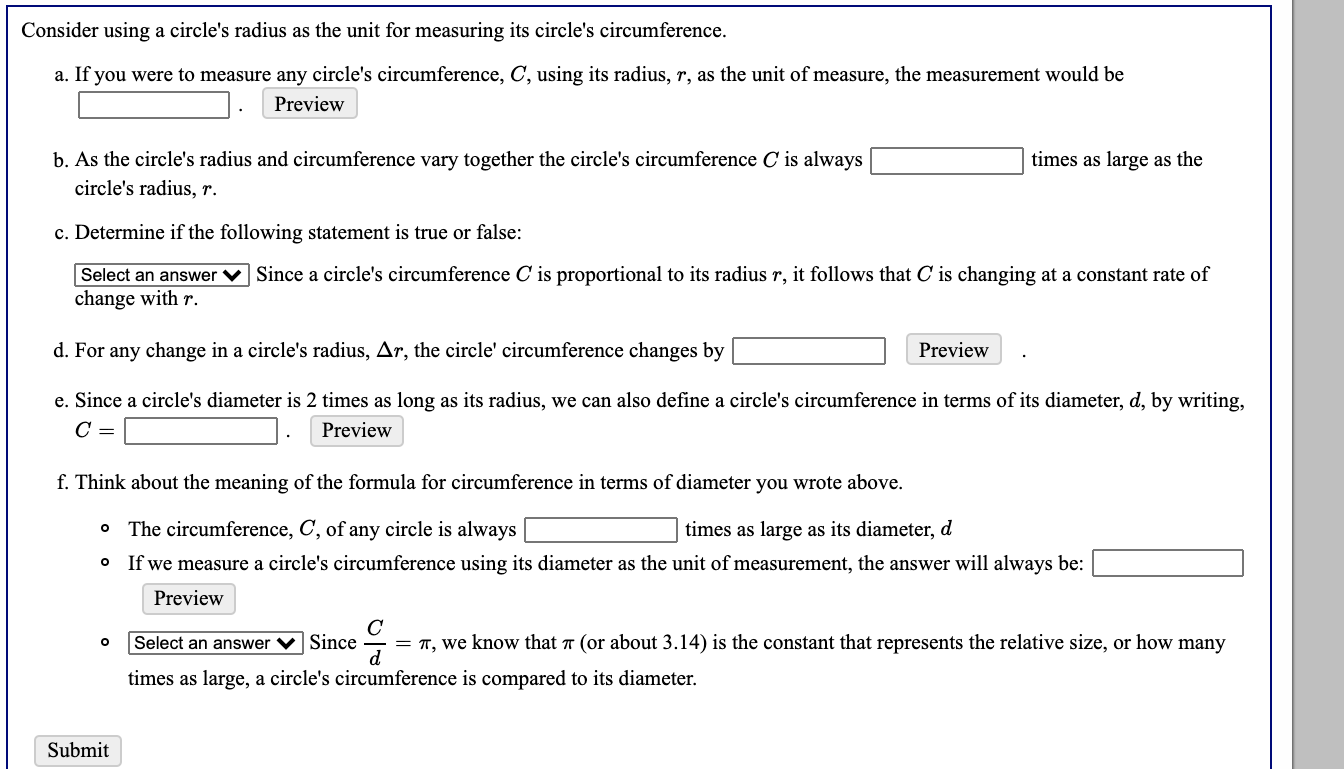
Consider using a circle's radius as the unit for measuring its circle's circumference. a. If you were to measure any circle's circumference, C, using its radius, r, as the unit of measure, the measurement would be 2?. b. As the circle's radius and circumference vary together the circle's circumference C is always 2? times as large as the circle's radius, r. c. Determine if the following statement is true or false: Since a circle's circumference C is proportional to its radius r, it follows that C is changing at a constant rate of change with r. True d. For any change in a circle's radius, ?r, the circle' circumference changes by 2?·?r. e. Since a circle's diameter is 2 times as long as its radius, we can also define a circle's circumference in terms of its diameter, d, by writing, C = ?d. f. Think about the meaning of the formula for circumference in terms of diameter you wrote above. - The circumference, C, of any circle is always ? times as large as its diameter, d. - If we measure a circle's circumference using its diameter as the unit of measurement, the answer will always be: ?. Since C/d = ?, we know that ? (or about 3.14) is the constant that represents the relative size, or how many times as large, a circle's circumference is compared to its diameter. Submit
View Answer
divider
ANSWERED

Dheeraj verified

Numerade educator

The applet below shows two line segments whose lengths represent the values of the radius and circumference of a circle. We will think about measuring the circumference using the radius as our unit of measure (or "unit ruler"). In the applet, you can vary the length of the radius by dragging the purple X's at the ends of the line segments. b. Drag the purple X to vary the circle's radius and consider how many times as long the circumference is compared to the radius. c. When the circle's radius is 1 cm, the circle's circumference is ______. d. When the circle's radius is 2.6 cm, the circle's circumference is ______. e. As the circle's radius and circumference vary together the circle's circumference is always ______ times as large as the circle's radius. f. As the circle's radius and circumference vary together, the ratio (or relative size) of the circumference to the radius, C/r = ______.

View Answer
divider
ANSWERED

Gregory Higby verified

Numerade educator

Your grandma's favorite cookie recipe calls for 3 cups of flour for every 2 cups of sugar. If ns represents the number of cups of sugar and nf represents the number of cups of flour, answer the following questions. a. Write a formula that defines the number of cups of flour, nf, needed for the recipe in terms of the number of cups of sugar, ns. Hint b. After mixing the ingredients for one batch of cookies you decide to make more cookies and add another 1.5 cup of sugar. How much flour should you add? c. Write a formula to represent any change in the number of cups of flour, ?nf, in terms of a change in the number of cups of sugar, ?ns. Hint

View Answer
divider
ANSWERED

Dheeraj verified

Numerade educator

Make sure you have explored the applet in the previous question before answering the following questions. d. On the graph below: i. construct a graph on the below axes to represent the square's perimeter, P, in terms of its square's side-length, s, ii. represent an increase in the square's side-length from 3 cm to 5 cm, iii. and represent the corresponding increase in the square's perimeter. Hint e. Determine the value of ?s as the square's side length s increases from 3 cm to 5 cm ?s = Preview f. As the value of s increases from 3 cm to 5 cm, the value of P Select an answer from cm to cm. g. Determine the value of ?P as s increases from 3 cm to 5 cm. ?P = Preview

View Answer
divider
ANSWERED

Dheeraj verified

Numerade educator

The applet below shows the square's side length and perimeter (in cm). Use the purple X at the bottom-right corner of the square to vary the size of the square. We can see that, as we vary the size of a square, the square's perimeter and area vary, as does the square's side-length. perimeter: 8.00 cm. x = 2.00 Drag the purple X at the bottom-right corner of the square to adjust the size of the square. a. Use the applet to give the square a side length of 4 cm. At this moment, what is the measure of the perimeter of the square (in cm)? b. Use the applet to give the square a side length of 1.8 cm. At this moment, what is the measure of the perimeter of the square (in cm)? c. Regardless of the size of the square the square's perimeter, P, is times as large as the square's side length, s. (Note that the units for measuring the square's side length and perimeter must be the same.)

View Answer
divider
INSTANT ANSWER

Suppose \( x \) and \( y \) are varying together at a constant rate of change and we know that the point \( (5,3) \) or the values \( x=5 \) and \( y=3 \) are in the relationship. Note: You can interact with the applet by moving the purple " \( X^{\prime \prime} \) on the horizontal axis to represent varying the value of \( x \). Before moving on to the next question, do the following. In the applet above, click on "Show Hypotenuse," and then vary the value of \( x \) from one value to another--do this several times and pay attention to how \( \Delta y \) and \( \Delta x \) are related as \( x \) and \( y \) vary in tandem. a. Determine if the following statements are true or false. i. Select an answer \( \boldsymbol{V} \) The slanted line (hypotenuse) in the applet represents values of \( x \) and \( y \) as they change together. ii. Select an answer \( \boldsymbol{V} \) The values \( x=2 \) and \( y=7 \), or point \( (2,7) \) is in the relationship represented by the above graph (the hypotenuse in the above applet). iii. Select an answer \( \boldsymbol{V} \) If the values of \( x \) and \( y \) are changing together at a constant rate of change of 2 , then \( y \) is always 2 times as large as \( x \). iv. Select an answer \( \boldsymbol{V} \) If the values of \( x \) and \( y \) vary together at a constant rate of change of 2 , then the value of \( \Delta y=2 \Delta x \) for any \( \Delta x \) away from a point \( \left(x_{1}, y_{1}\right) \) on the graph. b. What is the \( y \)-intercept of the above graph? \( y \)-intercept: Preview The value of the \( y \)-intercept represents the value of the Select an answer \( \boldsymbol{V} \) quantity when the Select an answer \( \boldsymbol{V} \) quantity has a value of 0 . c. Define the formula that represents \( y \) in terms of \( x \) for the graph displayed above. Preview

View Answer
divider
INSTANT ANSWER

The graph of the function \( h \) represents how the values of \( s \) and \( h(s) \) are related and vary together. Let \( V=h(s) \). Recall that \( s \) represents the length of the side of the square that is cut from each corner of a 15 inch by 18 inch of paper and \( h(s) \) represents the box's volume. Use the three modes in applet to answer the following questions. Drag the purple \( X \) to vary the value of the length of the side of the square cutout. a. Estimate \( h(2) \). Preview b. Solve \( h(s)=200 \) for \( s \). (Enter a comma-seperated list, if needed.) \( s= \) Preview c. As \( s \) increases from 3 to 5 , the value of \( h(s) \) Select an answer \( \boldsymbol{V} \) from to d. Determine the range of \( h \) ? Use interval notation. Preview e. Use the graph of \( h \) to evaluate \( \frac{h(2.5)-h(1)}{2.5-1} \) Select an answer \( \boldsymbol{V} \) Preview Which of the following decribes what \( \frac{h(2.5)-h(1)}{2.5-1} \) represents in the context of this problem. Select all that apply. The average rate of change of the box's volume with respect to the box's side-length, \( s \), on the interval from \( s=1 \) to \( s=2.5 \) inches. The constant rate of change of the box's volume with respect to its side length on the interval from \( s=1 \) to \( s=2.5 \) that would result in the same change in volume as was achieved by \( h \) on that interval. The ratio of the change in the box's volume and the change in the value of \( s \) on the interval from \( s=1 \) to \( s=2.5 \). The change in the box's volume as the value of \( s \) increases from 1 to \( 2.5 \).

View Answer
divider
ANSWERED

Dheeraj verified

Numerade educator

The graph of a function f is shown below. a. Evaluate f(4). f(4) = 2 b. Solve f(x) = 2 for x. x = 1 c. What is the vertical intercept of f? d. List all horizontal intercepts (or "roots") of f.

View Answer
divider
ANSWERED

Gregory Higby verified

Numerade educator

A tortoise and a hare are competing in a 2000-meter race. The arrogant hare decides to let the tortoise have a 530-meter head start. When the start gun is fired the hare begins running at a constant speed of 9 meters per second and the tortoise begins crawling at a constant speed of 5 meters per second. a. Define a function f to represent the tortoise's distance from the finish line (in meters) in terms of the number of seconds t since the start of the race. f(t) = b. Solve f(t) = 0 for t. t = c. Define a function g to represent the hare's distance from the finish line (in meters) in terms of the number of seconds t since the start of the race. g(t) = d. Solve g(t) = 0 for t. t = e. Who won the race? Select an answer

View Answer
divider