Background
Stephenson, age 55 and single, is a surgeon. Stephenson has accumulated a $2.0 million
investment portfolio that has a large concentration in small capitalization U.S. equities. After
further evaluation, Stephenson's financial advisor, Carolyn Coppa, has summarized the
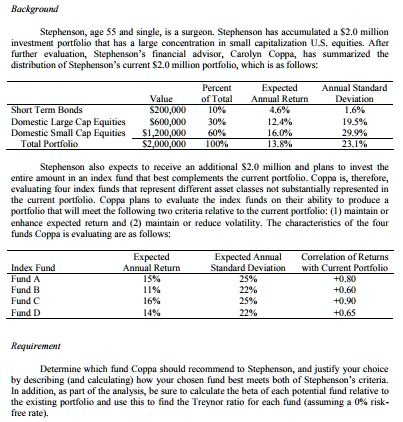
distribution of Stephenson's current $2.0 million portfolio, which is as follows:
Percent
Expected
Value
of Total
Annual Return
Annual Standard
Deviation
Short Term Bonds
$200,000
10%
4.6%
1.6%
Domestic Large Cap Equities
$600,000
30%
12.4%
19.5%
Domestic Small Cap Equities
$1,200,000
60%
16.0%
29.9%
Total Portfolio
$2,000,000
100%
13.8%
23.1%
Stephenson also expects to receive an additional $2.0 million and plans to invest the
entire amount in an index fund that best complements the current portfolio. Coppa is, therefore,
evaluating four index funds that represent different asset classes not substantially represented in
the current portfolio. Coppa plans to evaluate the index funds on their ability to produce a
portfolio that will meet the following two criteria relative to the current portfolio: (1) maintain or
enhance expected return and (2) maintain or reduce volatility. The characteristics of the four
funds Coppa is evaluating are as follows:
Index Fund
Expected
Expected Annual
Correlation of Returns
Annual Return
Standard Deviation
with Current Portfolio
Fund A
15%
25%
+0.80
Fund B
11%
22%
+0.60
Fund C
16%
25%
+0.90
Fund D
14%
22%
+0.65
Requirement
Determine which fund Coppa should recommend to Stephenson, and justify your choice
by describing (and calculating) how your chosen fund best meets both of Stephenson's criteria.
In addition, as part of the analysis, be sure to calculate the beta of each potential fund relative to
the existing portfolio and use this to find the Treynor ratio for each fund (assuming a 0% risk-
free rate).