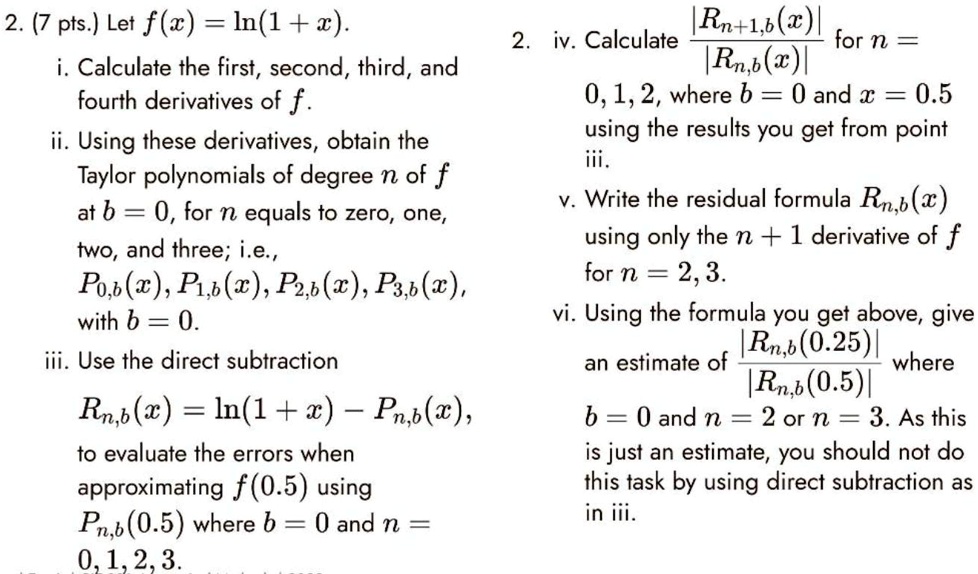
2. (7 pts.) Let $f(x) = \ln(1+x)$.
i. Calculate the first, second, third, and
fourth derivatives of $f$.
ii. Using these derivatives, obtain the
Taylor polynomials of degree $n$ of $f$
at $b = 0$, for $n$ equals to zero, one,
two, and three; i.e.,
$P_{0,b}(x)$, $P_{1,b}(x)$, $P_{2,b}(x)$, $P_{3,b}(x)$,
with $b = 0$.
iii. Use the direct subtraction
$R_{n,b}(x) = \ln(1+x) - P_{n,b}(x)$,
to evaluate the errors when
approximating $f(0.5)$ using
$P_{n,b}(0.5)$ where $b = 0$ and $n =$
0, 1, 2, 3.
2. iv. Calculate $\frac{|R_{n+1,b}(x)|}{|R_{n,b}(x)|}$ for $n =$
0, 1, 2, where $b = 0$ and $x = 0.5$
using the results you get from point
iii.
v. Write the residual formula $R_{n,b}(x)$
using only the $n + 1$ derivative of $f$
for $n = 2, 3$.
vi. Using the formula you get above, give
an estimate of $\frac{|R_{n,b}(0.25)|}{|R_{n,b}(0.5)|}$ where
$b = 0$ and $n = 2$ or $n = 3$. As this
is just an estimate, you should not do
this task by using direct subtraction as
in iii.