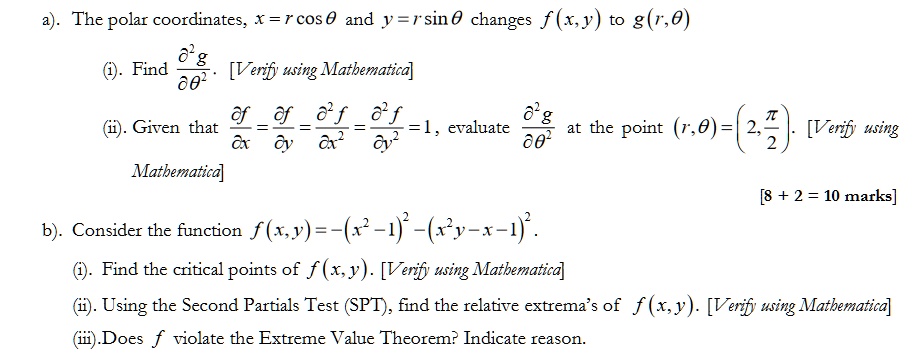
a). The polar coordinates, x = r cos ? and y = r sin ? changes f(x,y) to g(r,?)
(i). Find \frac{\partial^2 g}{\partial \theta^2}. [Verify using Mathematica]
(ii). Given that \frac{\partial f}{\partial x} = \frac{\partial f}{\partial y} = \frac{\partial^2 f}{\partial x^2} = \frac{\partial^2 f}{\partial y^2} = 1, evaluate \frac{\partial^2 g}{\partial \theta^2} at the point (r, ?) = \left(2, \frac{\pi}{2}\right). [Verify using Mathematica]
[8 + 2 = 10 marks]
b). Consider the function f(x,y) = -(x^2 - 1)^2 - (x^2y - x - 1)^2.
(i). Find the critical points of f(x, y). [Verify using Mathematica]
(ii). Using the Second Partials Test (SPT), find the relative extrema's of f(x, y). [Verify using Mathematica]
(iii). Does f violate the Extreme Value Theorem? Indicate reason.