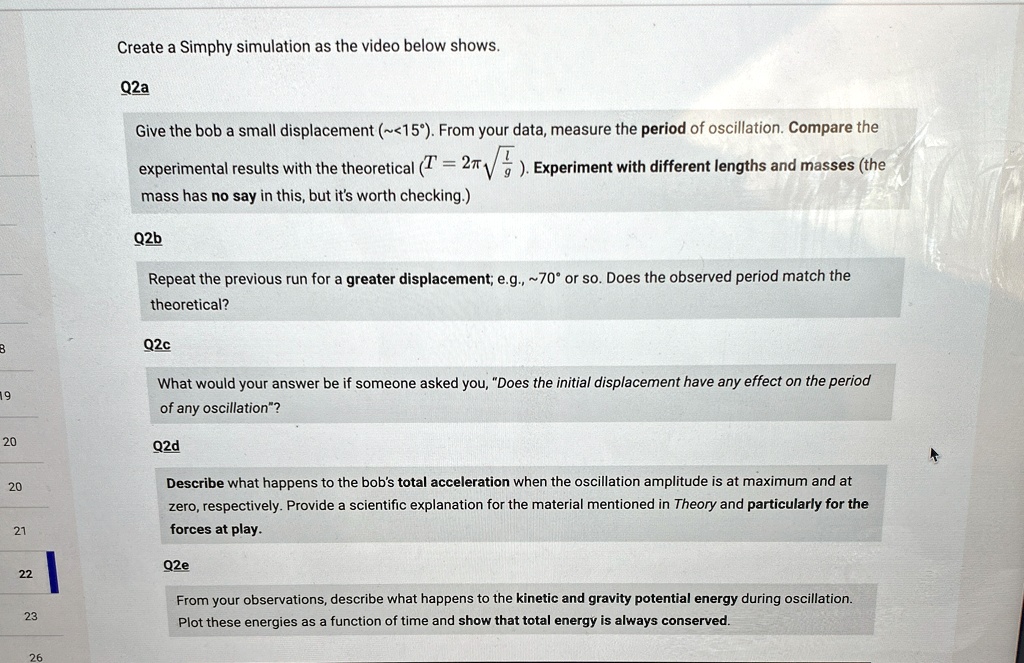
Create a Simphy simulation as the video below shows.
Q2a
Give the bob a small displacement (~<15°). From your data, measure the period of oscillation. Compare the
experimental results with the theoretical ($T = 2\pi \sqrt{\frac{l}{g}}$). Experiment with different lengths and masses (the
mass has no say in this, but it's worth checking.)
Q2b
Repeat the previous run for a greater displacement; e.g., ~70° or so. Does the observed period match the
theoretical?
Q2c
What would your answer be if someone asked you, "Does the initial displacement have any effect on the period
of any oscillation"?
Q2d
Describe what happens to the bob's total acceleration when the oscillation amplitude is at maximum and at
zero, respectively. Provide a scientific explanation for the material mentioned in Theory and particularly for the
forces at play.
Q2e
From your observations, describe what happens to the kinetic and gravity potential energy during oscillation.
Plot these energies as a function of time and show that total energy is always conserved.