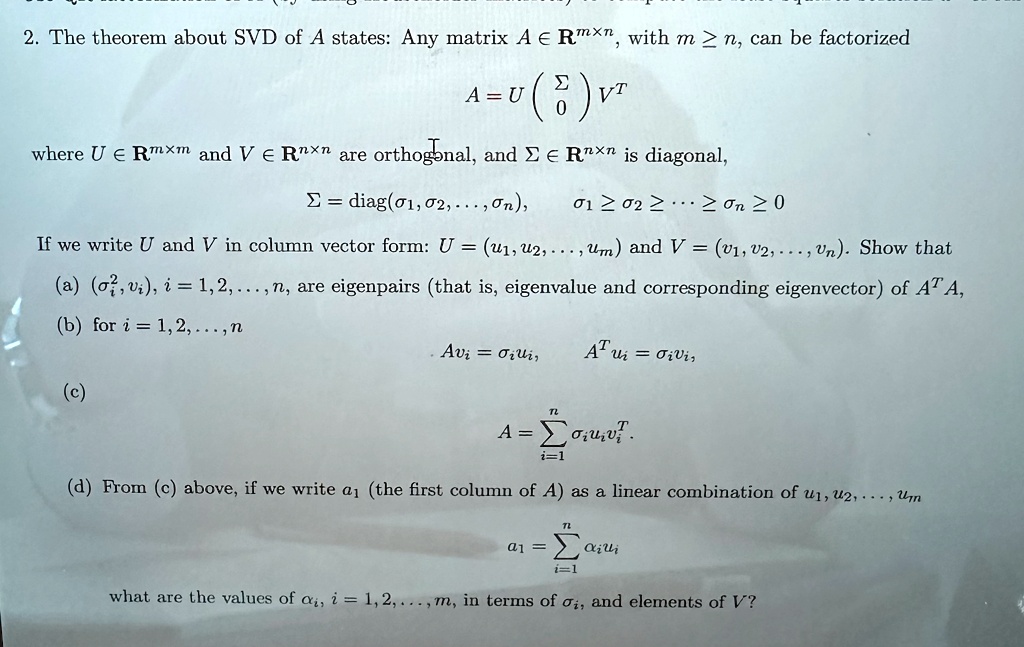
The theorem about SVD of A states: Any matrix A in R^(m×n), with m>=n, can be factorized as A=UΣV^(T) where U in R^(m×m) and V in R^(n×n) are orthogonal, and Σ in R^(n×n) is diagonal, Σ=diag(σ(1),σ(2),...,σ(n)), σ(1)>=σ(2)>=...>=σ(n)>=0. If we write U and V in column vector form: U=(u(1),u(2),...,u(m)) and V=(v(1),v(2),...,v(n)). Show that (a) (σ(i)^(2),v(i)), i=1,2,...,n, are eigenpairs (that is, eigenvalue and corresponding eigenvector) of A^(T)A, (b) for i=1,2,...,n Av(i)=σ(i)u(i), A^(T)u(i)=σ(i)v(i) (c) A=∑_(i=1)^(n) σ(i)u(i)v(i)^(T). (d) From (c) above, if we write a(1) (the first column of A) as a linear combination of u(1),u(2),...,u(m) a(1)=∑_(i=1)^(n) α(i)u(i) what are the values of α(i), i=1,2,...,m, in terms of σ(i), and elements of V?
The theorem about SVD of A states: Any matrix A in R^(m×n), with m>=n, can be factorized as A=U(Σ)V where U in R^(m×m) and V in R^(n×n) are orthogonal, and D in R^(n×n) is diagonal, D=diag(1,2,...,On), 0102..On0 If we write U and V in column vector form: U = (u1,u2,...,um) and V = (1,V2,...,Un). Show that (a) (?,v;), i = 1,2,...,n, are eigenpairs (that is, eigenvalue and corresponding eigenvector) of ATA bfori=1,2,...,n Avi=OiUi ATui=oiVi (c) A=Do;uvT. i=1 (d) From (c) above, if we write a (the first column of A) as a linear combination of ui,2,...,n a1= aiui i=1 what are the values of ai, i =1,2...,m,in terms of i, and elements of V?