Problem 5-6
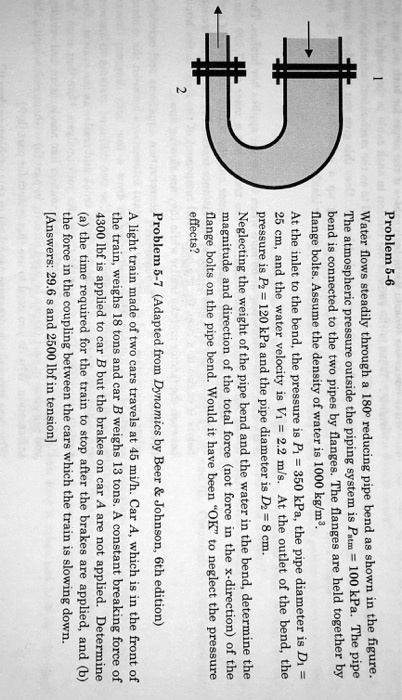
Water flows steadily through a 180° reducing pipe bend as shown in the figure.
The atmospheric pressure outside the piping system is $P_{atm} = 100 \text{ kPa}$. The pipe
bend is connected to the two pipes by flanges. The flanges are held together by
flange bolts. Assume the density of water is 1000 $kg/m^3$.
At the inlet to the bend, the pressure is $P_1 = 350 \text{ kPa}$, the pipe diameter is $D_1 =$
25 cm, and the water velocity is $V_1 = 2.2 \text{ m/s}$. At the outlet of the bend, the
pressure is $P_2 = 120 \text{ kPa}$ and the pipe diameter is $D_2 = 8 \text{ cm}$.
Neglecting the weight of the pipe bend and the water in the bend, determine the
magnitude and direction of the total force (not force in the x-direction) of the
flange bolts on the pipe bend. Would it have been \text{``OK''} to neglect the pressure
effects?
Problem 5-7 (Adapted from Dynamics by Beer & Johnson, 6th edition)
A light train made of two cars travels at 45 mi/h. Car A, which is in the front of
the train, weighs 18 tons and car B weighs 13 tons. A constant breaking force of
4300 lbf is applied to car B but the brakes on car A are not applied. Determine
(a) the time required for the train to stop after the brakes are applied, and (b)
the force in the coupling between the cars which the train is slowing down.
[Answers: 29.6 s and 2500 lbf in tension]