Questions asked
Linda Winkler
Numerade educator
The gravitational force on a ( 10 mathrm{~kg} ) object at a distance ( r ) meters from the center of the Earth is ( F=frac{4 imes 10^{15}}{r^{2}} ) Newtons. Find the work done in moving the object from the surface of the Earth to a height ( 10^{6} ) meters above the surface. The radius of the Earth is ( 6.4 imes 10^{6} ) meters.
William Semus
The pH of a solution is given by the formula pH = -0.4343 ln a, where a is the activity of hydrogen ions. How quickly is the hydrogen ion activity changing, when the pH of the solution is 3.5 and the pH is increasing at a rate of 0.6 per minute?
Israel Hernandez
Determine if the function is continuous at the specified point. If it is discontinuous, what type of discontinuity is it? [ f(x)=frac{2 x^{2}+5 x+2}{x+2} ext { at } x=-2 ]
Vincenzo Zaccaro
Consider the function with domain ( [0, infty) ) defined by [ f(x)=frac{1}{2+x^{2}} ] a) What is the range of ( f ) ? b) Is ( f ) increasing, decreasing or neither? Don't use the graph of ( f ) for justification. c) Explain briefly why ( f ) has an inverse. Calculate the inverse function and specify its domain.
Linda Hand
Find the area enclosed by the graphs of the functions ( y=x^{2}+1 ) and ( y=1-x^{2}+2 x ).
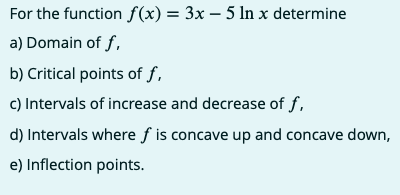
For the function ( f(x)=3 x-5 ln x ) determine a) Domain of ( f ), b) Critical points of ( f ), c) Intervals of increase and decrease of ( f ), d) Intervals where ( f ) is concave up and concave down, e) Inflection points.
Jeff Vermeire
Differentiate the following functions: a) ( f(x)=frac{x^{2}-1}{x^{2}+1} ) b) ( g(t)=sqrt{e^{-2 t+3}} ) c) ( h(y)=ln (3 y) sin ^{-1} y )
Evaluate the following integrals: a) ( int cos ^{4}(3 x) sin (3 x) d x ) b) ( int_{0}^{2} x e^{2 x} d x ) c) ( int_{1}^{4} frac{2 x}{3+x^{2}} d x )
Use the Fundamental Theorem of Calculus, Part 1 to find the derivative: [ frac{d}{d x} int_{4}^{sqrt{x}}left(t^{2}+ln t ight) d t ]
Suman Saurav Thakur
Find the volume of the solid generated by rotating around the x-axis the area enclosed by the curves y = x^2 and y = x.