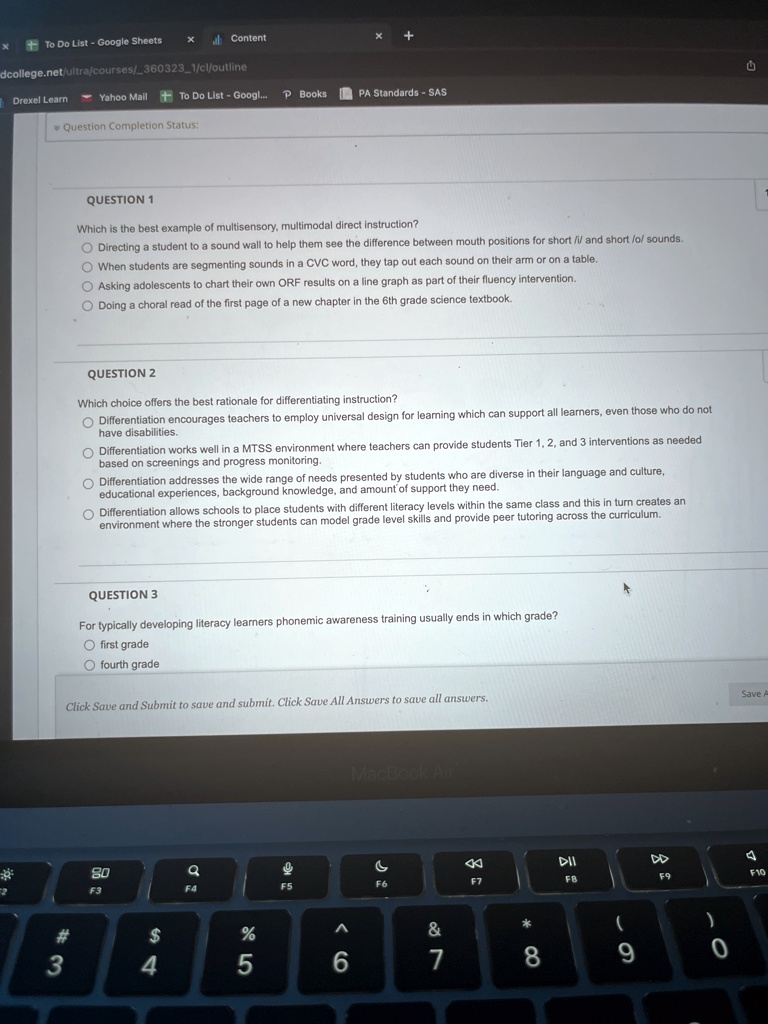
QUESTION 1
Which is the best example of multisensory, multimodal direct instruction?
Directing a student to a sound wall to help them see the difference between mouth positions for short /i/ and short /o/ sounds.
When students are segmenting sounds in a CVC word, they tap out each sound on their arm or on a table.
Asking adolescents to chart their own ORF results on a line graph as part of their fluency intervention.
Doing a choral read of the first page of a new chapter in the 6th grade science textbook.
QUESTION 2
Which choice offers the best rationale for differentiating instruction?
Differentiation encourages teachers to employ universal design for learning which can support all learners, even those who do not
have disabilities.
Differentiation works well in a MTSS environment where teachers can provide students Tier 1, 2, and 3 interventions as needed
based on screenings and progress monitoring.
Differentiation addresses the wide range of needs presented by students who are diverse in their language and culture,
educational experiences, background knowledge, and amount of support they need.
Differentiation allows schools to place students with different literacy levels within the same class and this in turn creates an
environment where the stronger students can model grade level skills and provide peer tutoring across the curriculum.
QUESTION 3
For typically developing literacy learners phonemic awareness training usually ends in which grade?
first grade
fourth grade
Click Save and Submit to save and submit. Click Save All Answers to save all answers.