Ace - AI Tutor
Ask Our Educators
Textbooks
My Library
Flashcards
Scribe - AI Notes
Notes & Exams
Download App
emily riggs

emily r.

Divider

Questions asked

BEST MATCH

The multiplier is the amount by which a change in _______ expenditure is magnified or multiplied to determine _______. autonomous; the change in investment that it generate

View Answer
divider
BEST MATCH

Based on survey research about jealousy conducted in the United States and many other countries around the world men become more jealous regarding ________ while women become more jealous regarding ________ O short-term commitment, long-term commitment O emotional infidelity, sexual infidelity O sexual infidelity, emotional infidelity O sexual infidelity, sexual infidelity

View Answer
divider
BEST MATCH

Catalyzed Reaction Rates and Activation Energies A reaction rate increases by a factor of 1600 in the presence of a catalyst at 14°C. The activation energy of the original, uncatalysed, pathway is 77 kJ mol-1. What is the activation energy of the catalyzed pathway, all other factors being equal?

View Answer
divider
BEST MATCH

Question 8 0.5 pts The central canal of a bone osteon contains osteocytes blood vessels and nerves red bone marrow yellow bone marrow

View Answer
divider
BEST MATCH

A professional athlete is confronted by his teammates and friends because they believe his steroid use has gotten out of control. Given the lessons learned by psychologists about how to define abnormal behavior, which of the following arguments is most likely to create consensus between the athlete and everyone else? Group of answer choices You use literally twice as high a dose as anyone I've heard of. This dosage is already doing serious damage to your body. The best version of you wouldn't need drugs to compete. Our whole team thinks staying drug-free is important.

View Answer
divider
BEST MATCH

Answer: reactants

View Answer
divider
BEST MATCH

It is estimated that hookworms infect an estimated 740 million people worldwide. Of the 25,000 or so identified species of related worms, Parascaris equorum is of particular interest because it has only two chromosomes as its complete diploid complement. Assume that both chromosomes of Parascaris are metacentric (centromere in the middle). Sketch below the appropriate chromosomal arrangement for each of the following five cell types: Primary spermatocyte (metaphase I), primary oocyte (metaphase I), first polar body, secondary oocyte, mitotic metaphase.

View Answer
divider
BEST MATCH

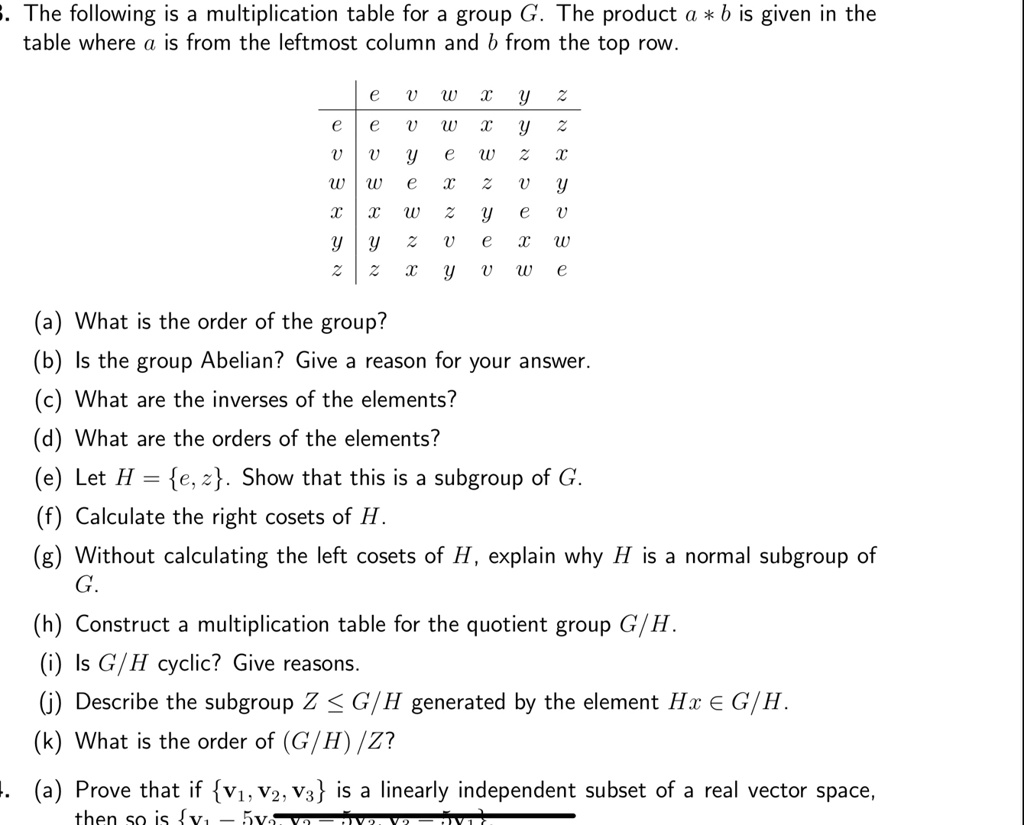
The following is a multiplication table for a group ( G ). The product ( a * b ) is The following is a multiplication table for a group G. The product a**b is given in the table where a is from the leftmost column and b from the top row. (a) What is the order of the group? (b) Is the group Abelian? Give a reason for your answer. (c) What are the inverses of the elements? (d) What are the orders of the elements? (e) Let H={e,z}. Show that this is a subgroup of G. (f) Calculate the right cosets of H. (g) Without calculating the left cosets of H, explain why H is a normal subgroup of G. (h) Construct a multiplication table for the quotient group (G)/(H). (i) Is (G)/(H) cyclic? Give reasons. (j) Describe the subgroup Z<=(G)/(H) generated by the element Hxin(G)/(H). (k) What is the order of ((G)/(H))/(Z) ? (a) Prove that if {v_(1),v_(2),v_(3)} is a linearly independent subset of a real vector space,given in the table where ( a ) is from the leftmost column and ( b ) from the top row. egin{tabular}{c|cccccc} & ( e ) & ( v ) & ( w ) & ( x ) & ( y ) & ( z ) \ hline( e ) & ( e ) & ( v ) & ( w ) & ( x ) & ( y ) & ( z ) \ ( v ) & ( v ) & ( y ) & ( e ) & ( w ) & ( z ) & ( x ) \ ( w ) & ( w ) & ( e ) & ( x ) & ( z ) & ( v ) & ( y ) \ ( x ) & ( x ) & ( w ) & ( z ) & ( y ) & ( e ) & ( v ) \ ( y ) & ( y ) & ( z ) & ( v ) & ( e ) & ( x ) & ( w ) \ ( z ) & ( z ) & ( x ) & ( y ) & ( v ) & ( w ) & ( e ) end{tabular} (a) What is the order of the group? (b) Is the group Abelian? Give a reason for your answer. (c) What are the inverses of the elements? (d) What are the orders of the elements? (e) Let ( H={e, z} ). Show that this is a subgroup of ( G ). (f) Calculate the right cosets of ( H ). (g) Without calculating the left cosets of ( H ), explain why ( H ) is a normal subgroup of ( G ). (h) Construct a multiplication table for the quotient group ( G / H ). (i) Is ( G / H ) cyclic? Give reasons. (j) Describe the subgroup ( Z leq G / H ) generated by the element ( H x in G / H ). (k) What is the order of ( (G / H) / Z ) ? (a) Prove that if ( left{mathbf{v}_{1}, mathbf{v}_{2}, mathbf{v}_{3} ight} ) is a linearly independent subset of a real vector space, The following is a multiplication table for a group G. The product a * b is given in the table where a is from the leftmost column and b from the top row. e v W x y e e w x y 2 v y e w x w w e x v y x x w y e y y e x m x y w e (a) What is the order of the group? (b) Is the group Abelian? Give a reason for your answer. (c) What are the inverses of the elements? (d) What are the orders of the elements? (e) Let H = {e, z}. Show that this is a subgroup of G. (f) Calculate the right cosets of H. (g) Without calculating the left cosets of H, explain why H is a normal subgroup of G. (h) Construct a multiplication table for the quotient group G/H (i) Is G/H cyclic? Give reasons. (j) Describe the subgroup Z < G/H generated by the element Hx E G/H. (k) What is the order of (G/H)/Z? (a) Prove that if {v1,V2,V} is a linearly independent subset of a real vector space then so is v.
View Answer
divider
BEST MATCH

Item 2 Part A Two forces, \overrightarrow{F}_1 = (1.20\hat{i} - 0.50\hat{j} + 0.65\hat{k}) \text{ N and } \overrightarrow{F}_2 = (-0.80\hat{i} + 1.20\hat{j}) \text{ N are applied on a moving object of mass 0.20 kg. The displacement vector produced by the two forces is } \overrightarrow{d} = (7.3\hat{i} + 8.3\hat{j} + 5.4\hat{k}) \text{ m.} What is the work done by the two forces? Express your answer with the appropriate units. W = Value Units

View Answer
divider
BEST MATCH

14.1 Amplifier Classification 14.1. Draw the ac equivalent circuits for, and classify (that is, as C-S, C-G, C-D, C-E, C-B, C-C, and not useful), the amplifiers in Fig. P14.1 (a) to (q). (a) ++ www C₁ HH RI www w R₂ R Ro RE ww +Vcc 21 VEL C₂ www.1. RA UI

View Answer
divider