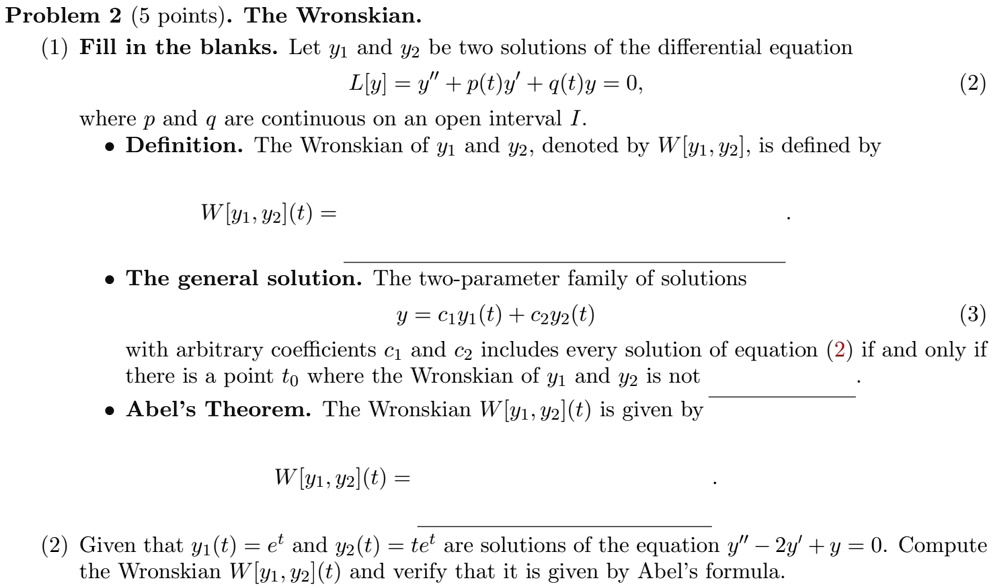
Problem 2 (5 points). The Wronskian.
(1) Fill in the blanks. Let $y_1$ and $y_2$ be two solutions of the differential equation
$L[y] = y'' + p(t)y' + q(t)y = 0$,
where $p$ and $q$ are continuous on an open interval $I$.
• Definition. The Wronskian of $y_1$ and $y_2$, denoted by $W[y_1, y_2]$, is defined by
$W[y_1, y_2](t) = $
• The general solution. The two-parameter family of solutions
y = c_1y_1(t) + c_2y_2(t)$
with arbitrary coefficients $c_1$ and $c_2$ includes every solution of equation (2) if and only if
there is a point $t_0$ where the Wronskian of $y_1$ and $y_2$ is not
• Abel's Theorem. The Wronskian $W[y_1, y_2](t)$ is given by
$W[y_1, y_2](t) = $
(2) Given that $y_1(t) = e^t$ and $y_2(t) = te^t$ are solutions of the equation $y'' - 2y' + y = 0$. Compute
the Wronskian $W[y_1, y_2](t)$ and verify that it is given by Abel's formula.