Ace - AI Tutor
Ask Our Educators
Textbooks
My Library
Flashcards
Scribe - AI Notes
Notes & Exams
Download App
emma white

emma w.

Divider

Questions asked

BEST MATCH

A website keeps track of predictions made by individuals in finance, politics, sports, and entertainment. The website kept track of 663663 stock predictions by a famed TV financial personality and author (such as recommendations to buy a stock) and found 303303 were correct predictions. Treat these 663663 predictions as a random sample of all of the TV personality's predictions. Does the sample evidence suggest the TV personality is correct less than half the time? Complete parts (a) through (f). Question content area bottom Part 1 (a) What is the variable of interest in this study? Is it qualitative with two outcomes? Explain. A. The variable of interest is whether or not the TV personality made a correct stock prediction. Therefore, it is qualitative with two possible outcomes. Your answer is correct. B. The variable of interest is the number of correct stock predictions made by the TV personality. Therefore, it is not qualitative with two possible outcomes. C. The variable of interest is whether or not the TV personality is correct less than half the time. Therefore, it is qualitative with two possible outcomes. D. The variable of interest is whether a stock rose or fell in price. Therefore, it is qualitative with two possible outcomes. Part 2 (b) What is the goal of the research? A. The goal of the research is to determine whether the TV personality is correct less than half the time. Your answer is correct. B. The goal of the research is to determine whether or not you would trust the TV personality's predictions. C. The goal of the research is to determine the total number of correct predictions made by the TV personality, using the sample as a basis. D. The goal of the research is to determine whether the website accurately tracks the TV personality's predictions. Part 3 (c) What are the null and alternative hypotheses? Let p represent the probability of a prediction being correct. Upper H 0H0: p ▼ not equals≠ equals= less than< greater than> enter your response here Upper H 1H1: p ▼ enter your response here

View Answer
divider
BEST MATCH

3. What is the role played by intermittent rate of contraction regarding sRPE? Is one type perceived as more difficult than the other? Why might this be?

View Answer
divider
BEST MATCH

A life-threatening side effect of bleomycin is A- cardiotoxicity B- myelosuppression C- pulmonary toxicity or D- hemorrhagic cystitis.

View Answer
divider
BEST MATCH

10. From past years of testing, the mean final score was 86 out of 100 with a standard deviation of 6.8. I want to conclude that this year's mean for the final will be higher than the past. I took a sample of 18 finals and found the mean to be 88 out of 100. At 5% can I make this conclusion?

View Answer
divider
BEST MATCH

Step 2 The next step is to sketch the feasible region based on the constraints. To do this, we sketch the equations $2x + 4y = 800$ and $x + y = 300$ as --Select--- lines. Note that the test point $(0, 0)$ ---Select--- satisfy all of the constraint inequalities, so the solution of the constraint system is the region on or ---Select--- the lines, in the first quadrant (since $x \ge 0$, $y \ge 0$). Be sure to extend the lines in both directions.

View Answer
divider
BEST MATCH

Consider a spherical 60 Watt glass light bulb surrounded by still air at 25 degrees Celsius. The bulb diameter is 6 cm. The bulb is located in a large room with a wall temperature of 20 degrees Celsius. The emissivity of glass is 0.6. Assume that the 60 W supplied to the bulb is transferred from the outside surface of the bulb by a combination of natural convection and radiation. (a) Calculate the surface temperature of the bulb. (b) Calculate the amount of heat transferred by radiation. (c) Calculate the amount of heat transferred by convection.

View Answer
divider
BEST MATCH

2. (This is McIntyre end-of-chapter problem 2.19.) A spin 1 particle is prepared in the state $\left|\psi_i\right\rangle = \frac{1}{\sqrt{6}}\left|1\right\rangle - \frac{1}{\sqrt{3}}\left|0\right\rangle + \frac{1}{\sqrt{2}}\left|-1\right\rangle$ Find the probability that the system is measured to be in the final state $\left|\psi_f\right\rangle = \frac{(1+i)}{\sqrt{7}}\left|1\right\rangle_y + \frac{2}{\sqrt{7}}\left|0\right\rangle_y - \frac{i}{\sqrt{7}}\left|-1\right\rangle_y$ Fixing typo Sep 28: Please replace 1/sqrt(2) with i/sqrt(2). (I meant to match the textbook exactly.)

View Answer
divider
BEST MATCH

For isothermal flows ($T = const.$): 1. Show that the one-dimensional Euler equations can be written as follows: $\frac{\partial}{\partial t}\rho + \frac{\partial}{\partial x}(\rho u) = 0$ $\frac{\partial}{\partial t}(\rho u) + \frac{\partial}{\partial x}(\rho (u^2 + c^2)) = 0$ where $c^2 = \left(\frac{\partial p}{\partial \rho}\right)_{T=const.} = RT.$

View Answer
divider
BEST MATCH

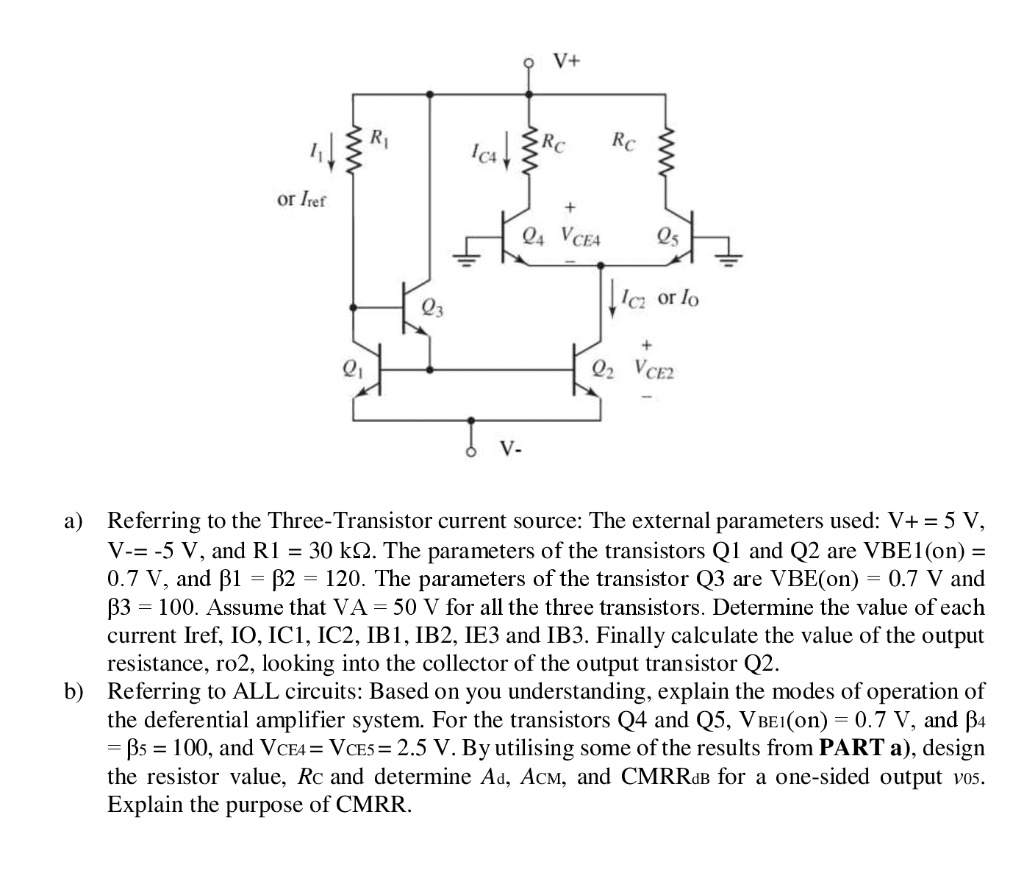
V+\n1\n1C4\nRC\nRC\nor Iref\n+\n24 VCEA\n25\nIc2 or lo\n23\n+\n21\n22 VCE2\nV-\na) Referring to the Three-Transistor current source: The external parameters used: V+ = 5 V,\nV-= -5 V, and R1 = 30 k?. The parameters of the transistors Q1 and Q2 are VBE1(on) =\n0.7 V, and ?1 = B2 = 120. The parameters of the transistor Q3 are VBE(on) = 0.7 V and\nB3 = 100. Assume that VA = 50 V for all the three transistors. Determine the value of each\ncurrent Iref, IO, IC1, IC2, IB1, IB2, IE3 and IB3. Finally calculate the value of the output\nresistance, ro2, looking into the collector of the output transistor Q2.\nb) Referring to ALL circuits: Based on you understanding, explain the modes of operation of\nthe deferential amplifier system. For the transistors Q4 and Q5, VBE1(on) = 0.7 V, and ?4\n= ?5 = 100, and VCE4 = VCE5= 2.5 V. By utilising some of the results from PART a), design\nthe resistor value, Rc and determine Ad, Acm, and CMRRdb for a one-sided output vos.\nExplain the purpose of CMRR.
View Answer
divider
BEST MATCH

Question 29 Not yet answered Marked out of 8.00 Flag question For the following circuit we wish to determine $V_o$. a) Based on the circuit analysis techniques you have learned (nodal, loop, Thevenin/Norton, superposition, etc) which method would you choose? Comment on your decision. [2] b) Solve for $V_o$ using your chosen method. [6] Upload your solution as a PDF attachment. 1 k$\Omega$ 2 mA 2 k$\Omega$ 12 V 1 k$\Omega$ Files 2 k$\Omega$ $V_o$ Maximum file size: 500MB, maximum number of files: 3

View Answer
divider