C. Answer the following questions after the experiment ( 6 pts each)
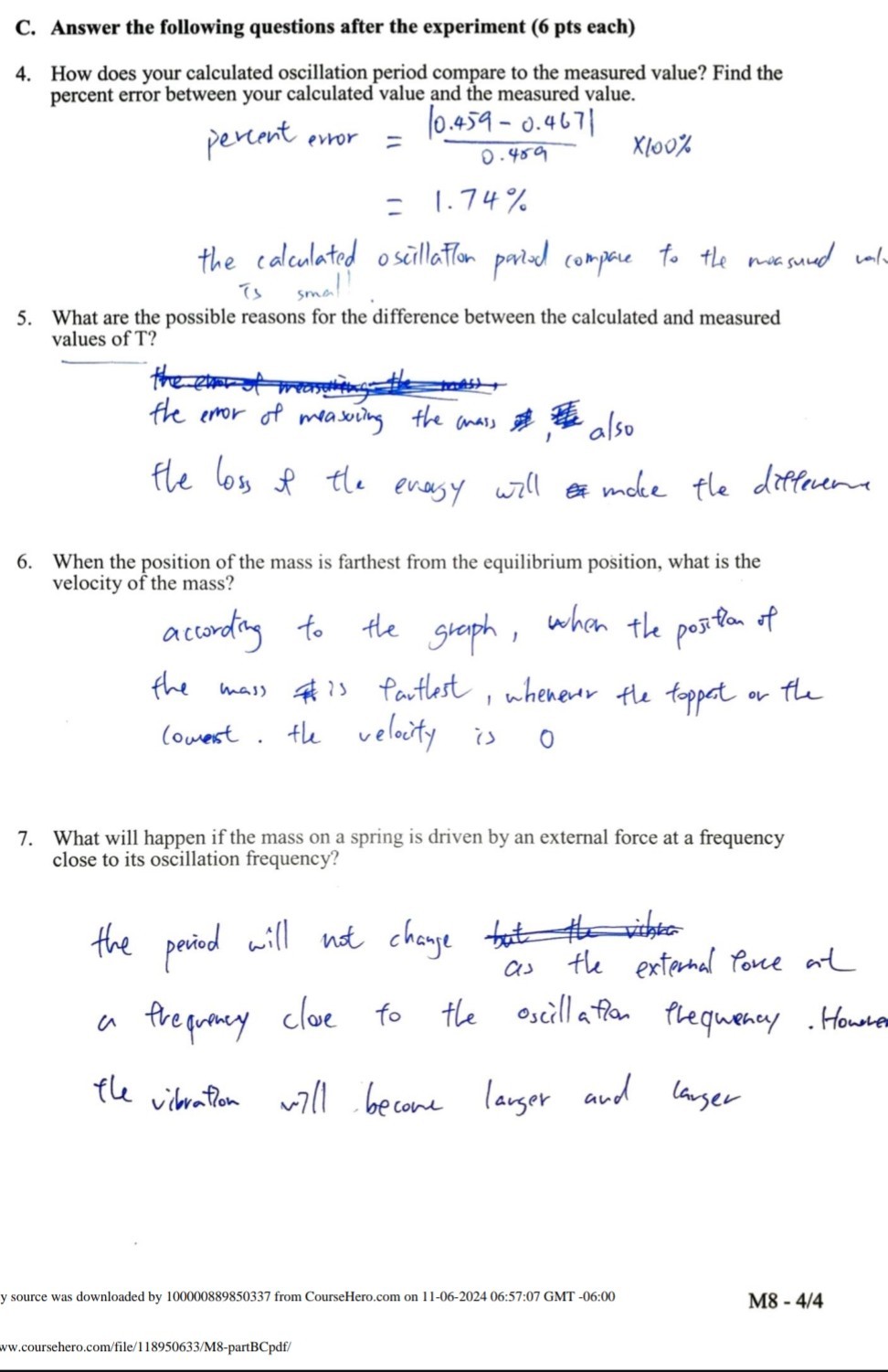
4. How does your calculated oscillation period compare to the measured value? Find the percent error between your calculated value and the measured value.
\[
\begin{aligned}
\text { percent error } & =\frac{|0.459-0.467|}{0.459} \times 100 \% \\
& =1.74 \%
\end{aligned}
\]
the calculated oscillation period compare to the masund valu
5. What are the possible reasons for the difference between the calculated and measured values of T ?
the loss \( A \) the evasy will make the dieforenere
6. When the position of the mass is farthest from the equilibrium position, what is the velocity of the mass?
according to the graph, when the position of
the mass ?is Partlest, whenerer the toppost or the comert. the veloity is 0
7. What will happen if the mass on a spring is driven by an external force at a frequency close to its oscillation frequency?
the period will not change
as the external Tone at
a trequency clore to the oscillation thequency. Howeren
the vibration w7ll becone lauger and langer
y source was downloaded by 100000889850337 from CourseHero.com on 11-06-2024 06:57:07 GMT -06:00
M8 - 4/4
ww.coursehero.com/file/118950633/M8-partBCpdf/