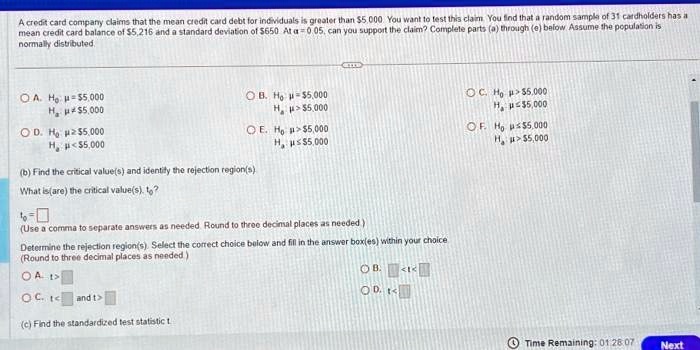
A credit card company claims that the mean credit card debt for individuals is greater than $5,000. You want to test this claim. You find that a random sample of 31 cardholders has a
mean credit card balance of $5,216 and a standard deviation of $650. At $\alpha = 0.05$, can you support the claim? Complete parts (a) through (e) below Assume the population is
normally distributed.
$\bigcirc$ A. $H_0: \mu = 55,000$
$H_a: \mu \neq 55,000$
$\bigcirc$ D. $H_0: \mu \geq 55,000$
$H_a: \mu < 55,000$
$\bigcirc$ B. $H_0: \mu = 55,000$
$H_a: \mu > 55,000$
$\bigcirc$ E. $H_0: \mu > 55,000$
$H_a: \mu \leq 55,000$
(b) Find the critical value(s) and identify the rejection region(s)
What is(are) the critical value(s), $t_\alpha$?
$t_\alpha = \Box$
(Use a comma to separate answers as needed. Round to three decimal places as needed)
Determine the rejection region(s). Select the correct choice below and fill in the answer box(es) within your choice
(Round to three decimal places as needed)
$\bigcirc$ C. $H_0: \mu > 55,000$
$H_a: \mu \leq 55,000$
$\bigcirc$ F. $H_0: \mu \leq 55,000$
$H_a: \mu > 55,000$
$\bigcirc$ A. $t > \Box$
$\bigcirc$ C. $t < \Box$ and $t > \Box$
(c) Find the standardized test statistic t
$\bigcirc$ B. $\Box < t < \Box$
$\bigcirc$ D. $t < \Box$