Ace - AI Tutor
Ask Our Educators
Textbooks
My Library
Flashcards
Scribe - AI Notes
Notes & Exams
Download App
enrique hall

enrique h.

Divider

Questions asked

BEST MATCH

Search the research literature to find three peer-reviewed studies substantiating the need to mitigate the negative effect of the organizational challenge you identified in Week 5 as the best opportunity for EBP improvement in a potential doctoral capstone project, as well as the significance of that improvement. Review and synthesize the substantiating evidence presented in your sources. Use the following questions as a guide: According to the literature: What is currently known about the challenge?How far-reaching is the challenge?What are the significant consequences of the challenge?What are the implications for not mitigating the negative effect of the challenge? Attach a draft review and synthesis of the evidence for all three of the peer-reviewed studies. Provide full APA-formatted references for your selected studies and include a description of the identified organizational challenge.

View Answer
divider
BEST MATCH

Question 3 (a) (i) Define the terms renewable and non-renewable as applied to energy sources. (b) Explain why geothermal energy is classed as both a renewable and non-renewable energy source. Do you agree with this explanation? (c) Sugar milling is a vital industry in South Africa, integrating the agricultural cultivation of sugarcane with the production of refined sugar. The fibrous residue generated during the extraction of sugar from shredded cane is known as bagasse. In various other countries, bagasse has been utilized as a fuel in factory boilers for the co-generation of steam and electricity. (i) How does sugarcane serve as a source of energy? (ii) List five Uses of Sugar Cane Bagasse as a Biofuel Source. (d) (i) What is nuclear energy? (ii) Briefly explain the reaction mechanism involved in nuclear energy. CHE3701/102/0/2025 7 (e) Write the reaction for the syngas production from ethane. [20]

View Answer
divider
BEST MATCH

the role of intermolecular forces on physical properties of organic compounds.

View Answer
divider
BEST MATCH

Consider the following Hamiltonian: H=ℏomega (a^(+)a-(sigma _(z))/(2))+epsi lon(asigma _(-)+a^(+)sigma _(+)) where [a,a^(+)]=1,sigma _(z) is the diagonal Pauli matrix, 2sigma _(-)=sigma _(x)-isigma _(y),2sigma _(+)=sigma _(x)+isigma _(y) and sigma _(x),sigma _(y) are the usual off-diagonal Pauli matrices. Consider the case where epsi lon≪ℏomega : Compute the leading non-vanishing correction to the first excited state(s). Consider the following Hamiltonian: H =hw(a+a -o/2)+e(ao_ +a+o+) where[a,a+]=1, is the diagonal Pauli matrix,2-=x - iy,2+=x+ iy and x, y are the usual off-diagonal Pauli matrices. Consider the case where < h: Compute the leading non-vanishing correction to the first excited state(s).

View Answer
divider
BEST MATCH

Complete the following table with the appropriate values for: • The $y$-coordinate of $Q$ • The slope of the secant line passing through points $P$ and $Q$ $x$ $y$ $m_{secant}$ 4.1 0.0000 0.0000 4.01 0.0000 0.0000 4.001 0.0000 0.0000 4.0001 0.0000 0.0000

View Answer
divider
BEST MATCH

Find the slope of the tangent line for the curve $r = 3 + \cos(3\theta)$ at $\theta = \frac{\pi}{2}$ \\ Show all steps clearly.

View Answer
divider
BEST MATCH

The cash flows from operating activities section of the statement of cash flows considers O interest expense. O cost of raw materials. O dividends paid. O stock repurchases. * Previous Next >

View Answer
divider
BEST MATCH

Initially uncharged four capacitors are connected as shown in the Figure. Here V=36V, V=16V. C2=4F, C6=6F, C=12F, and C4=60F. Find the energy stored on C6 capacitor in microjoules assuming sufficiently long time has passed for the current in the circuit to be zero. Solution: To find the energy stored on C6 capacitor, we can use the formula: Energy = (1/2) * C * V^2 First, let's calculate the voltage across C6 capacitor. Since the capacitors are connected in series, the total voltage across the circuit is equal to the sum of the individual voltages: V_total = V + V = 36V + 16V = 52V Next, let's calculate the equivalent capacitance of the circuit. Since the capacitors are connected in series, the reciprocal of the equivalent capacitance is equal to the sum of the reciprocals of the individual capacitances: 1/C_total = 1/C2 + 1/C6 + 1/C + 1/C4 1/C_total = 1/4F + 1/6F + 1/12F + 1/60F 1/C_total = (15 + 10 + 5 + 1)/60F 1/C_total = 31/60F C_total = 60F/31 Now, we can calculate the voltage across C6 capacitor using the voltage divider rule: V6 = V_total * (C6/C_total) V6 = 52V * (6F/(60F/31)) V6 = 52V * (6F * (31/60F)) V6 = 52V * (31/10) V6 = 161.2V Finally, we can calculate the energy stored on C6 capacitor: Energy = (1/2) * C6 * V6^2 Energy = (1/2) * 6F * (161.2V)^2 Energy = (1/2) * 6F * 25984.64V^2 Energy = 77953.92 microjoules
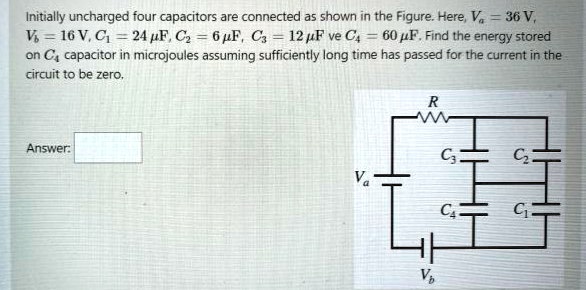
View Answer
divider
BEST MATCH

Problem 1. Recall that the position of a particle described in spherical coordinates is r = (cos \phi \hat{\mathbf{r}} + sin \phi \hat{\mathbf{\theta}}) \rho sin \theta + \rho cos \theta \hat{\mathbf{k}}. 1. Assume a central-force potential $V(\rho)$. Find two generalized momenta that are con- served during the motion. 2. Derive a second-order differential equation of motion for $\rho(t)$, and use the constants of motion to eliminate $\theta$ and $\phi$ from this equation. Problem 2. Let $\mathbf{m}(\mathbf{r})$ be the magnetic dipole moment density at position $\mathbf{r}$ in a ferromag- etic material at fixed temperature $T$. In Landau's theory of ferromagnetism we find $\mathbf{m}$ by minimizing the free energy functional $F[\mathbf{m}] = \int \frac{1}{2} \nabla \mathbf{m} \cdot \nabla \mathbf{m} + \beta(T_c - T) \mathbf{m}^2 + \gamma \mathbf{m}^4 dV$ where $T_c$ is some critical temperature and $\beta$ and $\gamma$ are positive constants 1. Derive a partial differential equation for the function $\mathbf{m}(\mathbf{r})$ that minimizes $F$. 2. Consider the special case where $\mathbf{m}(\mathbf{r})$ is constant in space; this constant value still depends on temperature, so call it $\mathbf{m}(T)$. Show that $\mathbf{m}(T) = 0$ whenever $T > T_c$. What is $\mathbf{m}(T)$ when $T \le T_c$? What is the physical significance of $T_c$?

View Answer
divider
BEST MATCH

A company has callable bonds outstanding with a par value of $100,000. The unamortized discount on these bonds is $1,500. The company called to retire these bonds and paid a call premium (bonus) of $3,000. What is the gain or loss on this retirement? A. $1,500 gain B. $3,000 loss C. $0 gain or loss D. $4,500 loss

View Answer
divider