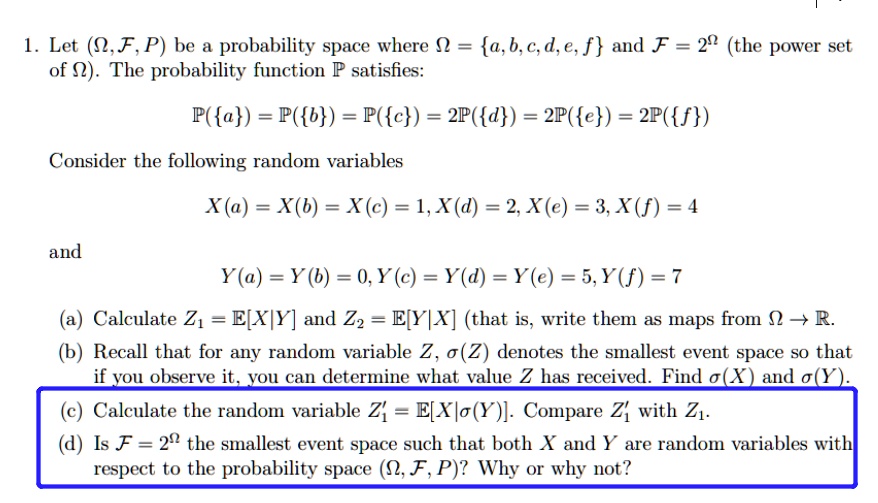
1. Let ($\Omega$, F, P) be a probability space where $\Omega$ = {a, b, c, d, e, f} and F = $2^{\Omega}$ (the power set
of $\Omega$). The probability function P satisfies:
P({a}) = P({b}) = P({c}) = 2P({d}) = 2P({e}) = 2P({f})
Consider the following random variables
and
X(a) = X(b) = X(c) = 1, X(d) = 2, X(e) = 3, X(f) = 4
Y(a) = Y(b) = 0, Y(c) = Y(d) = Y(e) = 5, Y(f) = 7
(a) Calculate $Z_1$ = E[X|Y] and $Z_2$ = E[Y|X] (that is, write them as maps from $\Omega \to \mathbb{R}$.
(b) Recall that for any random variable Z, $\sigma$(Z) denotes the smallest event space so that
if you observe it, you can determine what value Z has received. Find $\sigma$(X) and $\sigma$(Y).
(c) Calculate the random variable $Z_1'$ = E[X|$ \sigma$(Y)]. Compare $Z_1'$ with $Z_1$.
(d) Is F = $2^{\Omega}$ the smallest event space such that both X and Y are random variables with
respect to the probability space ($\Omega$, F, P)? Why or why not?