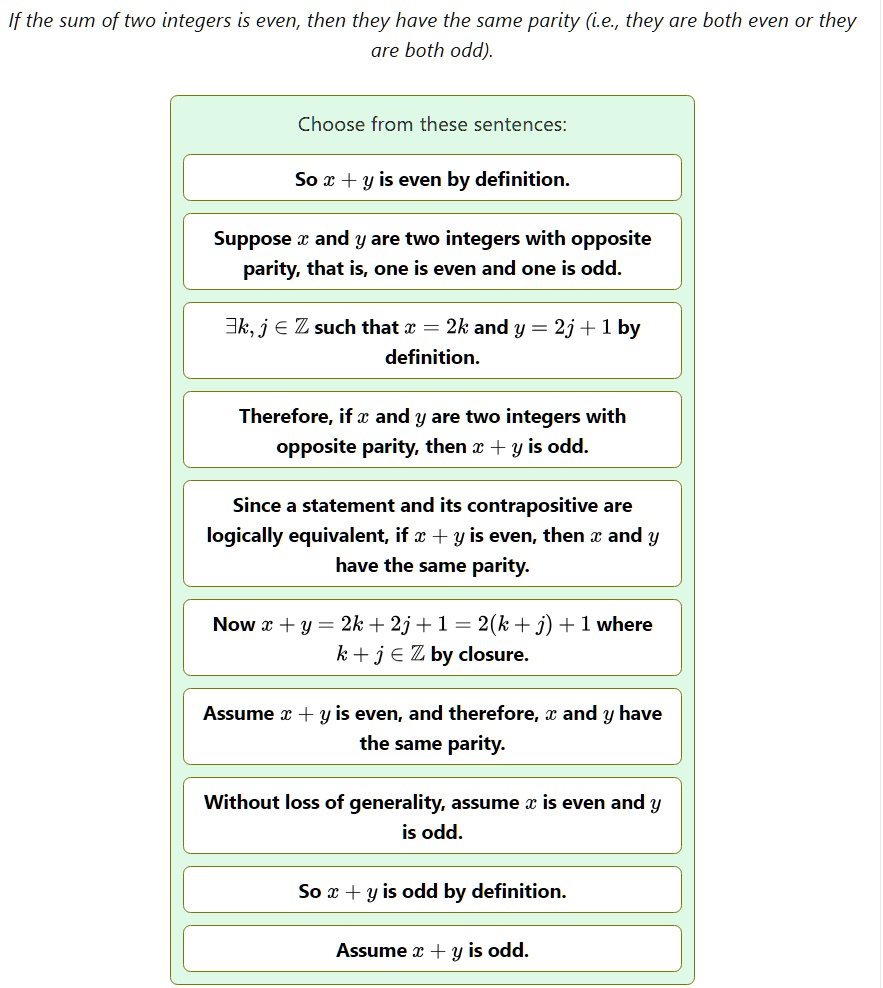
If the sum of two integers is even, then they have the same parity (i.e., they are both even or they
are both odd).
Choose from these sentences:
So $x + y$ is even by definition.
Suppose $x$ and $y$ are two integers with opposite
parity, that is, one is even and one is odd.
$\exists k, j \in \mathbb{Z}$ such that $x = 2k$ and $y = 2j + 1$ by
definition.
Therefore, if $x$ and $y$ are two integers with
opposite parity, then $x + y$ is odd.
Since a statement and its contrapositive are
logically equivalent, if $x + y$ is even, then $x$ and $y$
have the same parity.
Now $x + y = 2k + 2j + 1 = 2(k + j) + 1$ where
$k + j \in \mathbb{Z}$ by closure.
Assume $x + y$ is even, and therefore, $x$ and $y$ have
the same parity.
Without loss of generality, assume $x$ is even and $y$
is odd.
So $x + y$ is odd by definition.
Assume $x + y$ is odd.