a) For a stoichiometric mixture, which bi-propellant combination of liquid oxidizer and liquid fuel has the highest specific impulse amongst the liquid rocket propellants? [2 marks]
b) Name any two (out of six) types of the liquid rocket engine cycles? [4 marks]
c) Which chemical substance is primarily used as oxidizer in contemporary composite solid rocket propellants? What is the chemical formula of the substance in question? [4 marks]
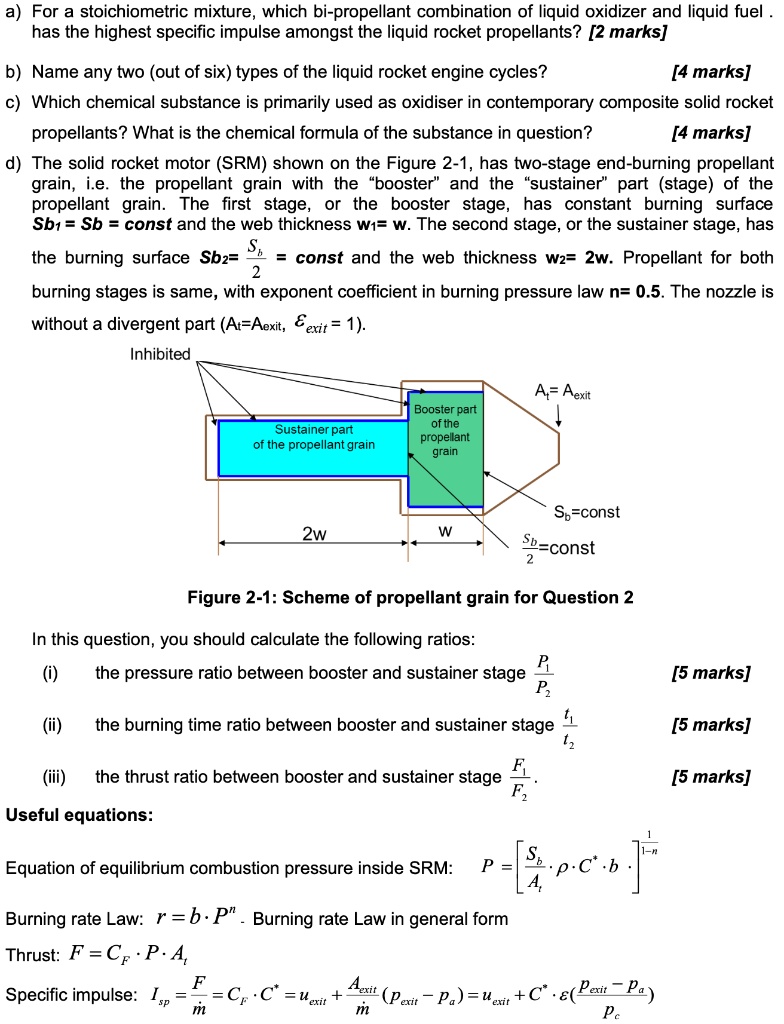
Grain, i.e. the propellant grain with the "booster" and the "sustainer" part (stage) of the propellant grain. The first stage, or the booster stage, has constant burning surface Sb1 = Sb = const and the web thickness w1 = w. The second stage, or the sustainer stage, has constant burning surface Sb2 = Sb = const and the web thickness w2 = 2w. The burning rate in both stages is the same, with exponent coefficient in the burning pressure law n = 0.5. The nozzle is without a divergent part (At = Aexit, θexit = 1).
Inhibited
A = Aexit
Booster part of the propellant grain
Sustainer part of the propellant grain
Sb = const
2w
W
Sb = const
2
Figure 2-1: Scheme of propellant grain for Question 2
In this question, you should calculate the following ratios:
(i) P, the pressure ratio between booster and sustainer stage.
[5 marks]
(ii) t, the burning time ratio between booster and sustainer stage.
F, the thrust ratio between booster and sustainer stage.
[5 marks]
(iii)
[5 marks]
Useful equations:
Equation of equilibrium combustion pressure inside SRM:
Burning rate Law: r = b - P^0.5. Burning rate Law in general form
Thrust: F = CpP.A
Specific impulse: I = F/m ̇ = Pc/pc