Ace - AI Tutor
Ask Our Educators
Textbooks
My Library
Flashcards
Scribe - AI Notes
Notes & Exams
Download App
eric charles

eric c.

Divider

Questions asked

BEST MATCH

Question 10 (2 points) Listen When strong acid and strong base are mixed the pH of the solution can be either acidic or basic at the equivalence point. a) True b) False

View Answer
divider
BEST MATCH

Events A and B are such that P(A) = 0.40 and P(AUB) = 0.85. Given that A and B are mutually exclusive, determine P(B).

View Answer
divider
BEST MATCH

what quantity of excess reactant remains when 0.48 mol of ga reacts with 0.39 mol of o2

View Answer
divider
BEST MATCH

\( 3 \times 4 d x \) primitiva: \( 1 / 4 \times 6+C \) \( 1 / 6 \times 6+C \)

View Answer
divider
BEST MATCH

Question 68 Which of the following is a true statement about organs? Each organ has a single function within the body. Failure of an individual organ can affect an entire organ system. Most organs function to provide the body with energy. An organ always contains at least three different tissue types. 1 pts

View Answer
divider
BEST MATCH

The skeletal muscle fiber(s) with the biggest diameter is/are a. type 1 and type 2a b. type 1 and type 2b c. type 1 d. type 2b e. type 2a

View Answer
divider
BEST MATCH

Find functions \(f\) and \(g\) so that \(h(x) = (g \circ f)(x)\), given that \(h(x) = (x+1)^{19}\)

View Answer
divider
BEST MATCH

The text appears to be free of spelling, typographical, grammatical, OCR, and mathematical errors.

View Answer
divider
BEST MATCH

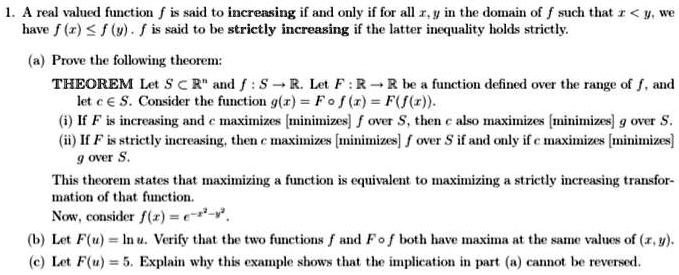
1. A real valued function $f$ is said to increasing if and only if for all $x$, $y$ in the domain of $f$ such that $x < y$, we have $f(x) \leq f(y)$. $f$ is said to be strictly increasing if the latter inequality holds strictly. (a) Prove the following theorem: THEOREM Let $S \subset \mathbb{R}^n$ and $f: S \to \mathbb{R}$. Let $F: \mathbb{R} \to \mathbb{R}$ be a function defined over the range of $f$, and let $c \in S$. Consider the function $g(x) = F \circ f(x) = F(f(x))$. (i) If $F$ is increasing and $c$ maximizes [minimizes] $f$ over $S$, then $c$ also maximizes [minimizes] $g$ over $S$. (ii) If $F$ is strictly increasing, then $c$ maximizes [minimizes] $f$ over $S$ if and only if $c$ maximizes [minimizes] g over $S$. This theorem states that maximizing a function is equivalent to maximizing a strictly increasing transformation of that function. Now, consider $f(x) = e^{-x^2 - y^2}$. (b) Let $F(u) = \ln u$. Verify that the two functions $f$ and $F \circ f$ both have maxima at the same values of $(x, y)$. (c) Let $F(u) = 5$. Explain why this example shows that the implication in part (a) cannot be reversed.
View Answer
divider
BEST MATCH

Question Positive: Gas prices increase by $1.25 every year. The price is already $3.50. How much will the gas price cost after 10 years?

View Answer
divider