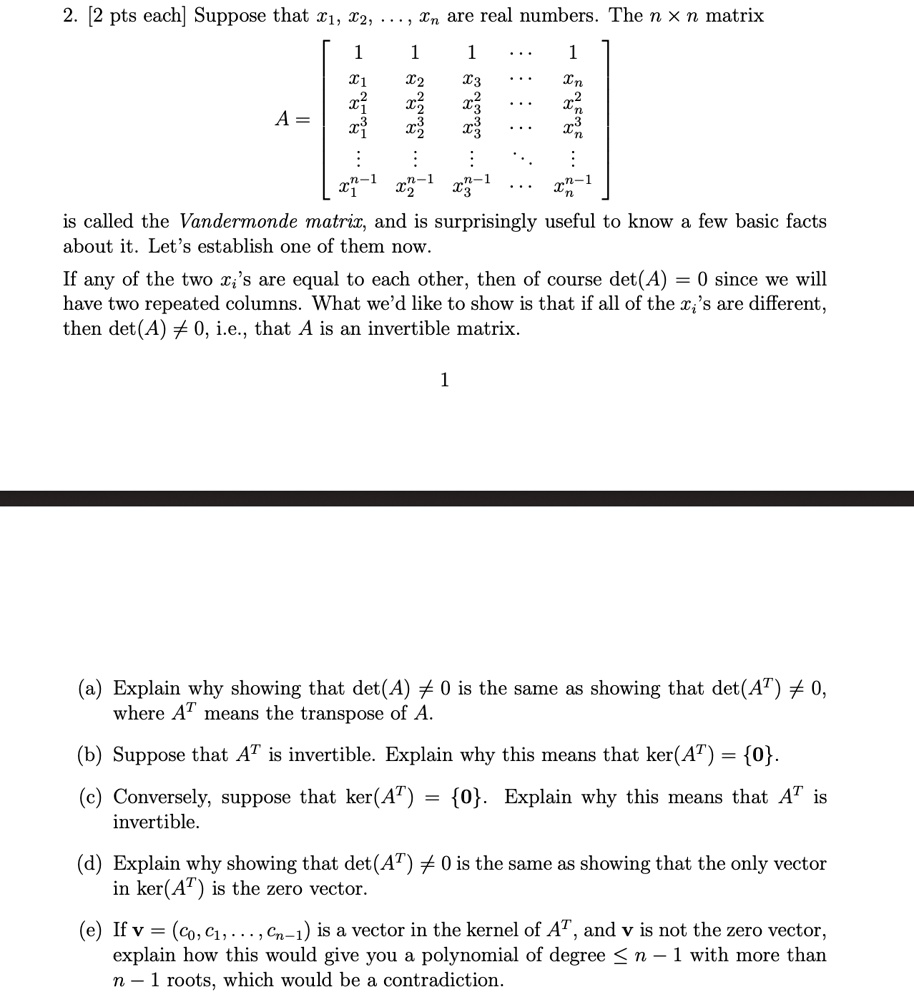
2. [2 pts each] Suppose that $x_1, x_2, \dots, x_n$ are real numbers. The $n \times n$ matrix
$$
A = \begin{bmatrix}
1 & 1 & 1 & \dots & 1 \\
x_1 & x_2 & x_3 & \dots & x_n \\
x_1^2 & x_2^2 & x_3^2 & \dots & x_n^2 \\
\vdots & \vdots & \vdots & \ddots & \vdots \\
x_1^{n-1} & x_2^{n-1} & x_3^{n-1} & \dots & x_n^{n-1}
\end{bmatrix}
$$
is called the Vandermonde matrix, and is surprisingly useful to know a few basic facts about it. Let's establish one of them now.
If any of the two $x_i$'s are equal to each other, then of course $\text{det}(A) = 0$ since we will have two repeated columns. What we'd like to show is that if all of the $x_i$'s are different, then $\text{det}(A) \ne 0$, i.e., that A is an invertible matrix.
(a) Explain why showing that $\text{det}(A) \ne 0$ is the same as showing that $\text{det}(A^T) \ne 0$, where $A^T$ means the transpose of $A$.
(b) Suppose that $A^T$ is invertible. Explain why this means that $\text{ker}(A^T) = \{0\}$.
(c) Conversely, suppose that $\text{ker}(A^T) = \{0\}$. Explain why this means that $A^T$ is invertible.
(d) Explain why showing that $\text{det}(A^T) \ne 0$ is the same as showing that the only vector in $\text{ker}(A^T)$ is the zero vector.
(e) If $v = (c_0, c_1, \dots, c_{n-1})$ is a vector in the kernel of $A^T$, and $v$ is not the zero vector, explain how this would give you a polynomial of degree $\le n - 1$ with more than $n - 1$ roots, which would be a contradiction.