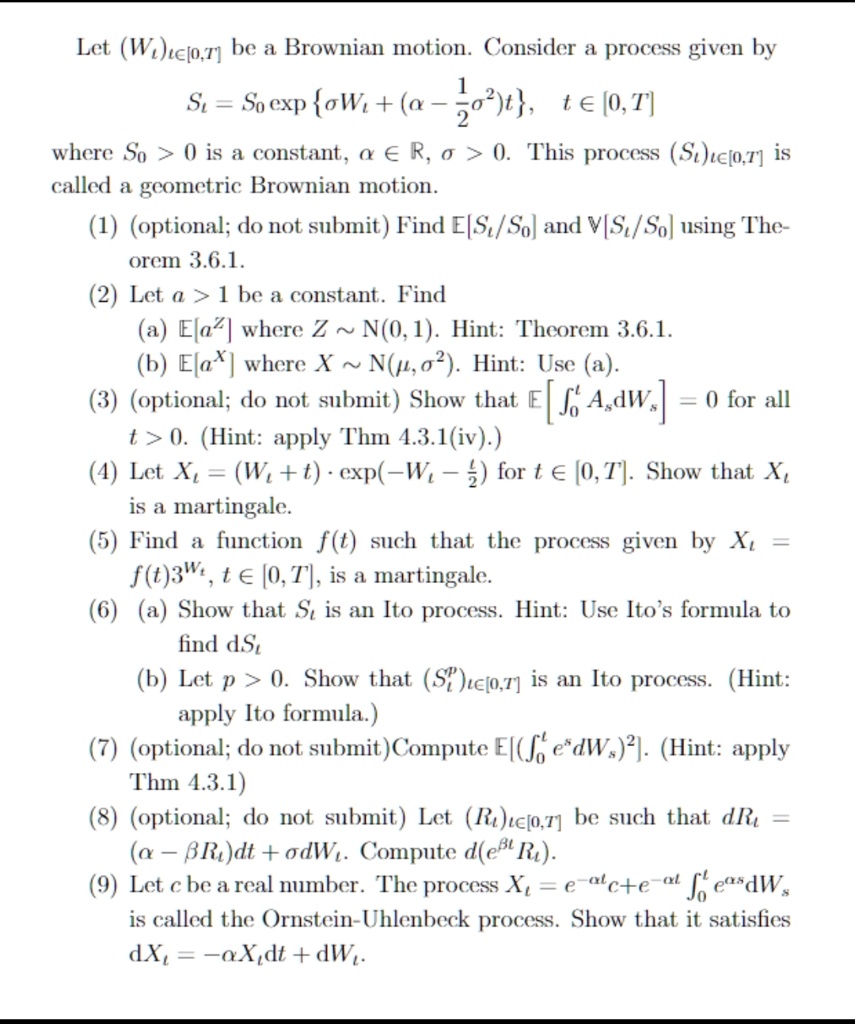
Let $(W_t)_{t \in [0, T]}$ be a Brownian motion. Consider a process given by
$$S_t = S_0 \exp\left\{ \theta W_t + \left( \alpha - \frac{1}{2}\theta^2 \right) t \right\}, \quad t \in [0, T]$$
where $S_0 > 0$ is a constant, $\alpha \in \mathbb{R}$, $\theta > 0$. This process $(S_t)_{t \in [0, T]}$ is called a geometric Brownian motion.
(1) (optional; do not submit) Find $E[S_t/S_0]$ and $V[S_t/S_0]$ using Theorem 3.6.1.
(2) Let $a > 1$ be a constant. Find
(a) $E[a^Z]$ where $Z \sim N(0, 1)$. Hint: Theorem 3.6.1.
(b) $E[a^X]$ where $X \sim N(\mu, \sigma^2)$. Hint: Use (a).
(3) (optional; do not submit) Show that $E \left[ \int_0^t A_s dW_s \right] = 0$ for all $t > 0$. (Hint: apply Thm 4.3.1(iv).)
(4) Let $X_t = (W_t + t) \cdot \exp(-W_t - \frac{t}{2})$ for $t \in [0, T]$. Show that $X_t$ is a martingale.
(5) Find a function $f(t)$ such that the process given by $X_t = f(t) 3W_t$, $t \in [0, T]$, is a martingale.
(6) (a) Show that $S_t$ is an Ito process. Hint: Use Ito's formula to find $dS_t$.
(b) Let $p > 0$. Show that $(S_t^p)_{t \in [0, T]}$ is an Ito process. (Hint: apply Ito formula.)
(7) (optional; do not submit) Compute $E \left[ \left( \int_0^t e^s dW_s \right)^2 \right]$. (Hint: apply Thm 4.3.1)
(8) (optional; do not submit) Let $(R_t)_{t \in [0, T]}$ be such that $dR_t = (\alpha - \beta R_t) dt + \sigma dW_t$. Compute $d(e^{\beta t} R_t)$.
(9) Let $c$ be a real number. The process $X_t = e^{-at} c + e^{-at} \int_0^t e^{as} dW_s$ is called the Ornstein-Uhlenbeck process. Show that it satisfies $dX_t = -aX_t dt + dW_t$.