Ace - AI Tutor
Ask Our Educators
Textbooks
My Library
Flashcards
Scribe - AI Notes
Notes & Exams
Download App
eric mcgee

eric m.

Divider

Questions asked

BEST MATCH

Question: If you use the simulation to create a molecule with six bonds around the central atom, what shape and logic apply? Square planar, because the bonds flatten to stay apart. Trigonal bipyramidal, to evenly distribute the bonds in all directions. Bent, since more bonds mean more bending. Octahedral, because six bonds are arranged at 90° angles to minimize repulsion.

View Answer
divider
BEST MATCH

After delivery, uterine arteries constrict and the uterus goes back to its original pre-pregnancy size due to the effects of the hormone .

View Answer
divider
BEST MATCH

CHAPTER 14 KINETICS OF A PARTICLE: WO 14-6. The force of F = 50 N is applied to the cord when s = 2 m. If the 6-kg collar is orginally at rest, determine its velocity at s = 0. Neglect friction. 1.5 m S F Prob. 14-6 A

View Answer
divider
BEST MATCH

Solve the equation by completing the square. The equation has real number solutions. x^(2)+10x=-16

View Answer
divider
BEST MATCH

An amateur astronomer decides to build a telescope from a discarded pair of eyeglasses. One of the lenses has a refractive power of 16 diopters, while the other has a refractive power of 1.8 diopters. (a) Which lens should be the objective? (b) How far apart should the lenses be separated? (c) What is the angular magnification of the telescope? (a) 1.8 (b) Number 0.6185 Units m (c) Number 8.8 Units No units

View Answer
divider
BEST MATCH

Archaeans share most closely the following characteristic with Bacteria. Group of answer choices the structure of their cell walls the occurrence of introns in their chromosomes methanogenesis the shape of their chromosomes and plasmids nucleotide sequence of small subunit ribosomal RNA

View Answer
divider
BEST MATCH

QUESTION 10 The police present you with 4 unsolved missing persons cases from the area where the remains were found. Which of the missing persons described below is most likely the individual the hiker found in the woods? A 56-year-old white male with gray hair and blue eyes, 6'1" in height, 210 lbs, went missing 2 years ago while on a hunting trip with his buddies in the same woods. He had a previous leg injury that had not healed well and he walked with a marked limp. He was presumed to have gotten himself lost when the group separated to find deer. A 24-year-old white female with red hair and green eyes, 5'5" in height, 126 lbs, went missing 3 years ago. She was last seen walking into her apartment building with her boyfriend. On the night she disappeared neighbors reported hearing shouting and a loud bang around 2am. A 27-year-old Hispanic male with blond hair and brown eyes, 5'9" in height, 167 lbs, went missing 5 years ago. He was a semi-pro boxer, last seen leaving the parking lot of a fight venue at 11pm. A 17-year-old African-American female with brown hair and eyes, 5'7" in height, 153 lbs, went missing 11 months ago. She was last seen by neighbors packing her car in the driveway with 2 beach chairs and a cooler at 9am.

View Answer
divider
BEST MATCH

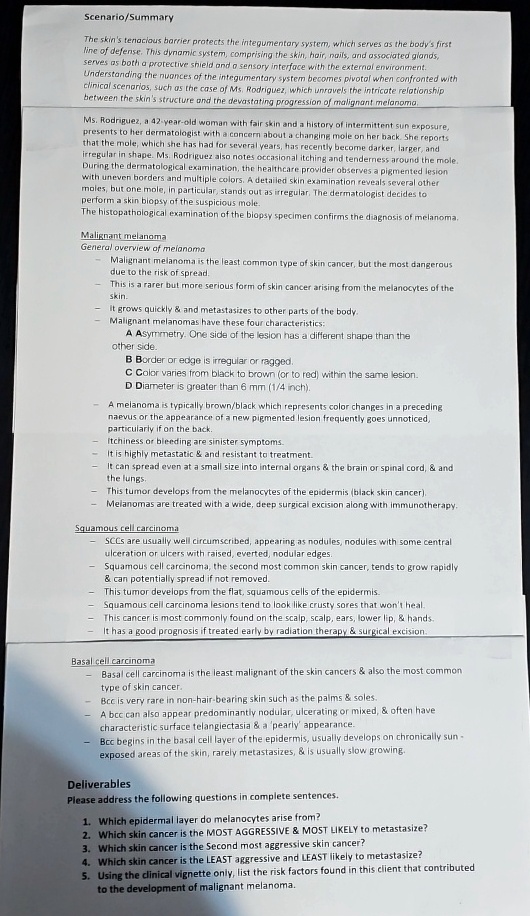
Scenario/Summary. The skin's tenacious barrier protects the integumentary system, which serves as the body's first line of defense. This dynamic system, comprising the skin, hair, nails, and associated glands, serves as both a protective shield and a sensory interface with the external environment. Understanding the nuances of the integumentary system becomes pivotal when confronted with clinical scenarios, such as the case of Ms. Rodriguez, which unravels the intricate relationship between the skin's structure and the devastating progression of malignant melanoma. Ms. Rodriguez, a 42-year-old woman with fair skin and a history of intermittent sun exposure, presents to her dermatologist with a concern about a changing mole on her back. She reports that the mole, which she has had for several years, has recently become darker, larger, and irregular in shape. Ms. Rodriguez also notes occasional itching and tenderness around the mole. During the dermatological examination, the healthcare provider observes a pigmented lesion with uneven borders and multiple colors. A detailed skin examination reveals several other moles, but one mole, in particular, stands out as irregular. The dermatologist decides to perform a skin biopsy of the suspicious mole. The histopathological examination of the biopsy specimen confirms the diagnosis of melanoma. Malignant melanoma General overview of melanoma Malignant melanoma is the least common type of skin cancer, but the most dangerous due to the risk of spread. This is a rarer but more serious form of skin cancer arising from the melanocytes of the skin. It grows quickly & and metastasizes to other parts of the body. Malignant melanomas have these four characteristics: A Asymmetry. One side of the lesion has a different shape than the other side. B Border or edge is irregular or ragged. C Color varies from black to brown (or to red) within the same lesion. D Diameter is greater than 6 mm (1/4 inch). A melanoma is typically brown/black which represents color changes in a preceding naevus or the appearance of a new pigmented lesion frequently goes unnoticed, particularly if on the back. Itchiness or bleeding are sinister symptoms. It is highly metastatic & and resistant to treatment. It can spread even at a small size into internal organs & the brain or spinal cord, & and the lungs. This tumor develops from the melanocytes of the epidermis (black skin cancer). Melanomas are treated with a wide, deep surgical excision along with immunotherapy. Squamous cell carcinoma SCCs are usually well circumscribed, appearing as nodules, nodules with some central ulceration or ulcers with raised, everted, nodular edges. Squamous cell carcinoma, the second most common skin cancer, tends to grow rapidly & can potentially spread if not removed. This tumor develops from the flat, squamous cells of the epidermis. Squamous cell carcinoma lesions tend to look like crusty sores that won't heal. This cancer is most commonly found on the scalp, scalp, ears, lower lip, & hands. It has a good prognosis if treated early by radiation therapy & surgical excision. Basal cell carcinoma Basal cell carcinoma is the least malignant of the skin cancers & also the most common type of skin cancer. Bcc is very rare in non-hair-bearing skin such as the palms & soles. A bcc can also appear predominantly nodular, ulcerating or mixed, & often have characteristic surface telangiectasia & a 'pearly' appearance. Bcc begins in the basal cell layer of the epidermis, usually develops on chronically sun - exposed areas of the skin, rarely metastasizes, & is usually slow growing. Deliverables Please address the following questions in complete sentences. 1. Which epidermal layer do melanocytes arise from? 2. Which skin cancer is the MOST AGGRESSIVE & MOST LIKELY to metastasize? 3. Which skin cancer is the Second most aggressive skin cancer? 4. Which skin cancer is the LEAST aggressive and LEAST likely to metastasize? 5. Using the clinical vignette only, list the risk factors found in this client that contributed to the development of malignant melanoma.
View Answer
divider
BEST MATCH

2. In this experiment, thin layer chromatography will be utilized to follow the progress of the reaction. Which compound is expected to have a higher $R_f$ value, fluorene or the product fluorenone? Support your answer. (3 pts) 3. The procedure calls for stirring of the reaction mixture to be discontinued while developing the TLC plate to monitor the progress of the reaction. Propose a reason why stirring of the reaction must be stopped during this time. (4 pts)

View Answer
divider
BEST MATCH

AOE 3124, Aerospace Structures PLEDGE Homework # 5, Due March 15, 2024 1. The attached figure shows a non-uniform, hollow, thin-walled circular tube of uniform thickness, $t_h$, rotating about an axis passing through one of its ends, O. The length of the tube is L. The mean radius of the circular tube, $r_m$, is given as: $r_m(x) = R \left(1 + \sin \frac{\pi x}{L}\right)$ $T_O$, $\alpha$, $\omega$ $\xi$ $X$ $\Delta \xi$ (a) A nonuniform hollow, circular bar rotating about point O $\alpha_\theta = \xi \alpha$ $\Delta F_x$ $\alpha_r = \xi \omega$ $\Delta \xi$ $\Delta M \alpha_\theta$ $\Delta M g$ $\Delta F_x(\xi) = \Delta M \alpha_r = \Delta M \xi \omega^2$ $\Delta F_y(\xi) = -\Delta M(\alpha_\theta + g) = -\Delta M(\xi \alpha + g)$ $\Delta M = 2 \pi r_m(\xi) t_h \Delta \xi$ (b) Inertia forces acting on a differential element at a distance, $\xi$, from O at $t = 0$ Figure 1: A non-uniform, thin-walled circular tube, rotating about O with an angular speed, $\omega$. $M_L = 0.5M$

View Answer
divider