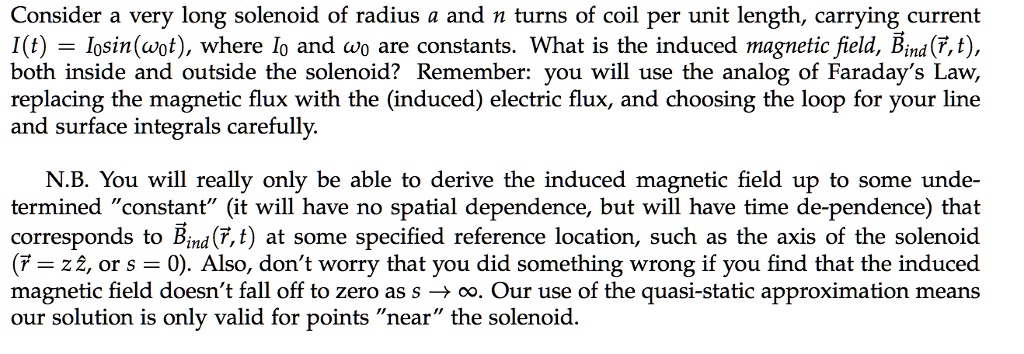
Consider a very long solenoid of radius a and n turns of coil per unit length, carrying current
I(t) = I<sub>0</sub>sin(?<sub>0</sub>t), where I<sub>0</sub> and ?<sub>0</sub> are constants. What is the induced magnetic field, \vec{B}<sub>ind</sub>(\vec{r}, t),
both inside and outside the solenoid? Remember: you will use the analog of Faraday's Law,
replacing the magnetic flux with the (induced) electric flux, and choosing the loop for your line
and surface integrals carefully.
N.B. You will really only be able to derive the induced magnetic field up to some unde-
termined \"constant\" (it will have no spatial dependence, but will have time de-pendence) that
corresponds to \vec{B}<sub>ind</sub>(\vec{r}, t) at some specified reference location, such as the axis of the solenoid
(\vec{r} = z\hat{z}, or s = 0). Also, don't worry that you did something wrong if you find that the induced
magnetic field doesn't fall off to zero as s ? ?. Our use of the quasi-static approximation means
our solution is only valid for points \"near\" the solenoid.