Ace - AI Tutor
Ask Our Educators
Textbooks
My Library
Flashcards
Scribe - AI Notes
Notes & Exams
Download App
eric pinilla

eric p.

Divider

Questions asked

BEST MATCH

Question 23 Which of the following fungal structures are diploid? A. hyphae B. spores C. zygote D. heterkaryotic stage C D A, B, D B and C

View Answer
divider
BEST MATCH

Question 7 Match the Suicide typologies with their descriptions. Prompts 1 Egoistic 2 Anomic 3 Fatalistic 4 Altruistic Answers Select match lack of social regulation in society, unclear norms, rules, values over-integration; social bonds are too strong over-regulation low integration in society; social bonds are weak

View Answer
divider
BEST MATCH

Q2e Given L=67 mH (milli H) R=353 (kilo Ohm) a) Write the parameters of the transfer function H(s). H(s)= Hz b) Calculate the cutoff frequency in rad/sec and in Hz. c) State the phase angle of the output voltage when fully in the passband region where d) State the phase angle of the output voltage when fully in the passband region where

View Answer
divider
BEST MATCH

An IV of ranitidine hydrochloride (Zantac) 50mg in 100 mL D5W is to run over 45 minutes.The tubing has a drip factor of 15. How many drops per minute should you del

View Answer
divider
BEST MATCH

Consider f(x)=6x-4 and g(x)=x^(2)+5x-13. You must combine all like terms before you submit your answer. You must expand all products before your submit your answer. a. What is the sum of f(x) and g(x) ? (f+g)(x)= b. What is the difference of g(x) from f(x) ? (f-g)(x)= c. What is the difference of f(x) from g(x) ? (g-f)(x)= d. What is the product of f(x) and g(x) ? (fg)(x)= e. What is the quotient of f(x) by g(x) ? ((f)/(g))(x)= f. What is the quotient of g(x) by f(x) ? ((g)/(f))(x)= Consider f(x) = 6x - 4 and g(x) = x2+ 5x - 13. You must combine all like terms before you submit your answer. You must expand all products before your submit your answer. a. What is the sum of f() and g()? (f+g)(x) b. What is the difference of g() from f()? (f-g)(x) c. What is the difference of f() from g()? b d. What is the product of f() and g()? fq) e. What is the quotient of f() by g()? f. What is the quotient of g() by f()?

View Answer
divider
BEST MATCH

Fund Which of the following statements correctly compares price and quantity in a competitive industry to those of a "green" industry for a product that generates pollution? The competitive market quantity will be lower than that in the green industry, whereas the competitive market price will be higher than that in the green industry. The competitive market quantity will be higher than that in the green industry, whereas the competitive market price will be lower than that in the green industry. O The competitive market price and quantity will both be the same as price and quantity in the green industry. The competitive market price and quantity will both be higher than price and quantity in the green industry.

View Answer
divider
BEST MATCH

Urea is synthesized in large quantities for use as a plant fertilizer and animal feed additive. Question 31 options: True False

View Answer
divider
BEST MATCH

Microeconomics is concerned with the market price and equilibrium quantity of each good or service. Question 13 options: True False

View Answer
divider
BEST MATCH

With a constant reactor period of 100 seconds, how long will it take to change power from 7% to 100%? \begin{equation*} t = \tau \left( \ln \frac{P}{P_0} \right) \end{equation*}

View Answer
divider
BEST MATCH

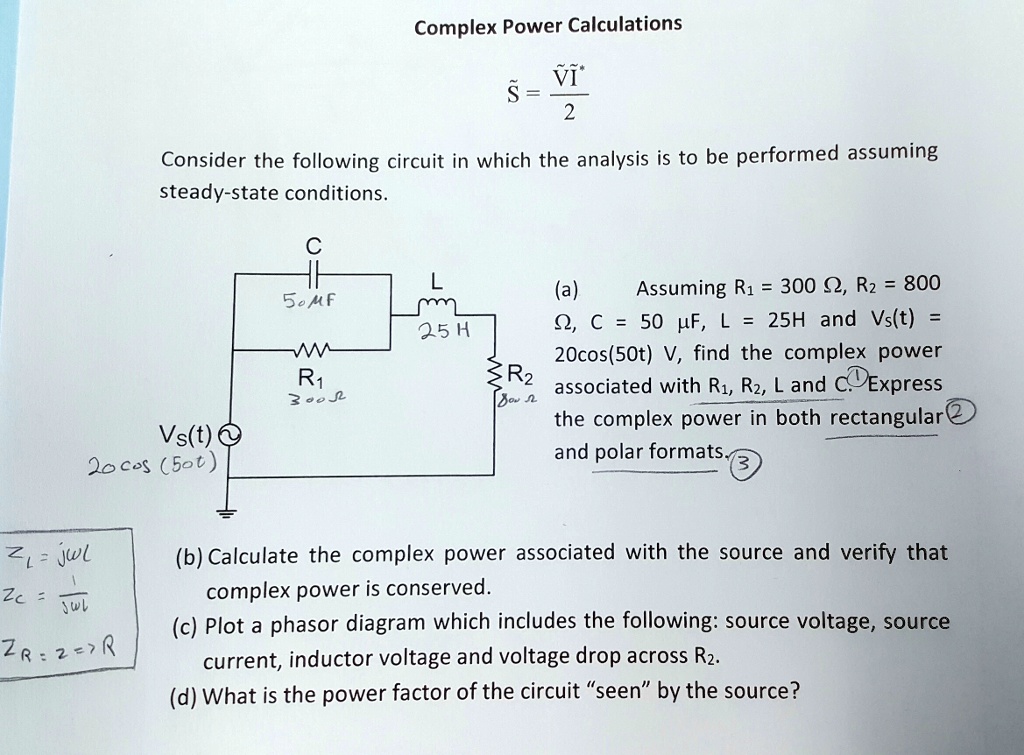
Complex Power Calculations \tilde{S} = \frac{\tilde{V}\tilde{I}^*}{2} Consider the following circuit in which the analysis is to be performed assuming steady-state conditions. (a) Assuming $R_1 = 300 \Omega$, $R_2 = 800$ $\Omega$, $C = 50 \mu F$, $L = 25H$ and $V_s(t) =$ $20cos(50t)$ V, find the complex power associated with $R_1$, $R_2$, L and C. Express the complex power in both rectangular and polar formats. (b) Calculate the complex power associated with the source and verify that complex power is conserved. (c) Plot a phasor diagram which includes the following: source voltage, source current, inductor voltage and voltage drop across $R_2$. (d) What is the power factor of the circuit \"seen\" by the source?
View Answer
divider