Create LP models in Excel to solve these models - turn in the spreadsheets.
Outstanding in Their Field.docx
The recent drought/price of corn has hit farmers hard. See the supplemental handout from NET.
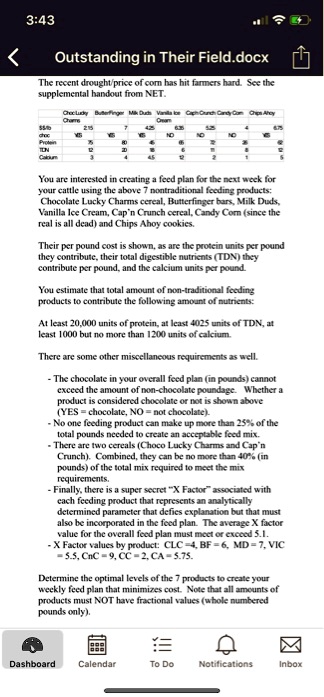
Check the table below:
Product Cost per pound Protein units per pound Total digestible nutrients (TDN) per pound Calcium units per pound
Chocolate Lucky Charms cereal $2.15 5.56 Yes Protein
Butterfinger bars $2.15 5.56 No Protein
Milk Duds $2.15 5.56 No Protein
Vanilla Ice Cream $2.15 5.56 No Protein
Cap'n Crunch cereal $2.15 5.56 Yes Protein
Candy Corn (since the real is all dead) $2.15 5.56 No Protein
Chips Ahoy cookies $2.15 5.56 No Protein
You are interested in creating a feed plan for the next week for your cattle using the above 7 nontraditional feeding products: Chocolate Lucky Charms cereal, Butterfinger bars, Milk Duds, Vanilla Ice Cream, Cap'n Crunch cereal, Candy Corn (since the real is all dead), and Chips Ahoy cookies.
Their per pound cost is shown, as are the protein units per pound they contribute, their total digestible nutrients (TDN) they contribute per pound, and the calcium units per pound.
You estimate that the total amount of non-traditional feeding products needs to contribute the following amount of nutrients:
- At least 20,000 units of protein
- At least 4,025 units of TDN
- At least 1,000 but no more than 1,200 units of calcium
There are some other miscellaneous requirements as well:
- The chocolate in your overall feed plan (in pounds) cannot exceed the amount of non-chocolate poundage. Whether a product is considered chocolate or not is shown above (YES = chocolate, NO = not chocolate).
- No one feeding product can make up more than 25% of the total pounds needed to create an acceptable feed mix.
- There are two cereals (Choco Lucky Charms and Cap'n Crunch). Combined, they can be no more than 40% (in pounds) of the total mix required to meet the mix requirements.
- Finally, there is a super secret X Factor associated with each feeding product that represents an analytically determined parameter that defies explanation but that must also be incorporated into the feed plan. The average X factor value for the overall feed plan must meet or exceed 5.1.
X Factor values:
CLC = 5.5
BF = 9
MD = 2
VI = 5.75
CnC = 5.5
CC = 9
CA = 2
Determine the optimal levels of the 7 products to create your weekly feed plan that minimizes cost. Note that all amounts of products must NOT have fractional values (whole-numbered pounds only).
Dashboard
Calendar
To Do
Notifications
Inbox