Part 1 of 5
For the following function, create a second derivative sign chart in order to identify inflection points.
\[
f(x)=-4 x^{4}+48 x^{3}+5
\]
Find the first derivative: \( f^{\prime}(x)=-16 x^{3}+144 x^{2} \)
Find the second derivative: \( f^{\prime \prime}(x)=-48 x^{2}+288 x \)
Part 2 of 5
We are interested in \( x \)-values where the second derivative changes sign. In this problem, \( f^{\prime \prime}(x) \) is defined and continuous for all \( x \). So, when they occur, sign changes will take place where \( f^{\prime \prime}(x)=0 \). Solve \( f^{\prime \prime}(x)=0 \) :
\[
-48 x^{2}+288 x=0
\]
Factor completely the left side.
\[
-48 x(x-6) \quad \checkmark=0
\]
Part 3 of 5
Thus, solutions to \( f^{\prime \prime}(x)=0 \) are
\[
x=0,6
\]
Part 4 of 5
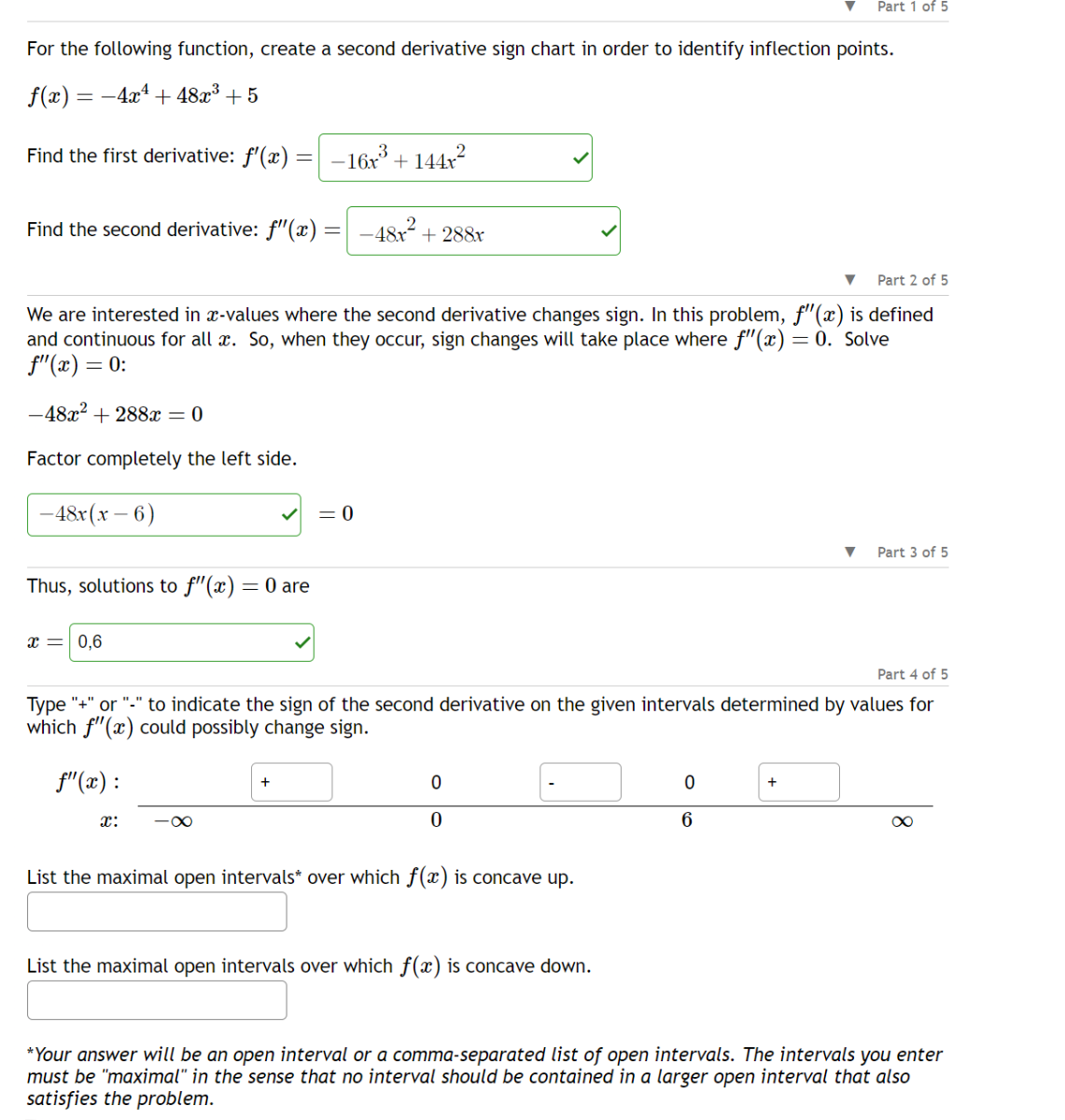
Type "+" or "-" to indicate the sign of the second derivative on the given intervals determined by values for which \( f^{\prime \prime}(x) \) could possibly change sign.
\[
\begin{array}{cccccc}
f^{\prime \prime}(x): & + & 0 & + \\
x: & 0 & - & 6 & \infty
\end{array}
\]
List the maximal open intervals* over which \( f(x) \) is concave up.
List the maximal open intervals over which \( f(x) \) is concave down.
*Your answer will be an open interval or a comma-separated list of open intervals. The intervals you enter must be "maximal" in the sense that no interval should be contained in a larger open interval that also satisfies the problem.