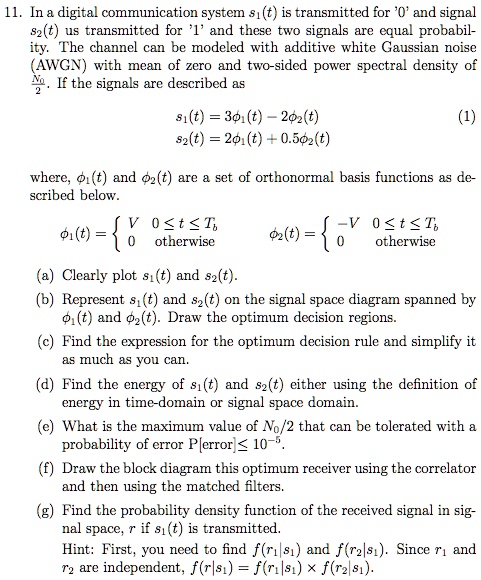
11. In a digital communication system, s1(t) is transmitted for '0' and signal s2(t) is transmitted for '1', and these two signals are equal probability. The channel can be modeled with additive white Gaussian noise (AWGN) with a mean of zero and a two-sided power spectral density of . If the signals are described as:
s1(t) = 3√(t) - 2√(t)
(1)
s2(t) = 2√(t) + 0.5√(t)
where t and t are a set of orthonormal basis functions as described below.
V0(t) = 1, t < 0
V0(t) = 0, otherwise
P(t) =
a) Clearly plot s1(t) and s2(t)
b) Represent s(t) and s2(t) on the signal space diagram spanned by (t) and 2(t). Draw the optimum decision regions.
c) Find the expression for the optimum decision rule and simplify it as much as you can.
d) Find the energy of s1(t) and s2(t) either using the definition of energy in the time-domain or signal space domain.
e) What is the maximum value of No/2 that can be tolerated with a probability of error P[error] = 10^-5.
f) Draw the block diagram of this optimum receiver using the correlator and then using the matched filters.
g) Find the probability density function of the received signal in signal space, r, if s(t) is transmitted. Hint: First, you need to find f(r|s) and f(r|s). Since r and s are independent, f(r|s) = f(r|s) * f(r|s).