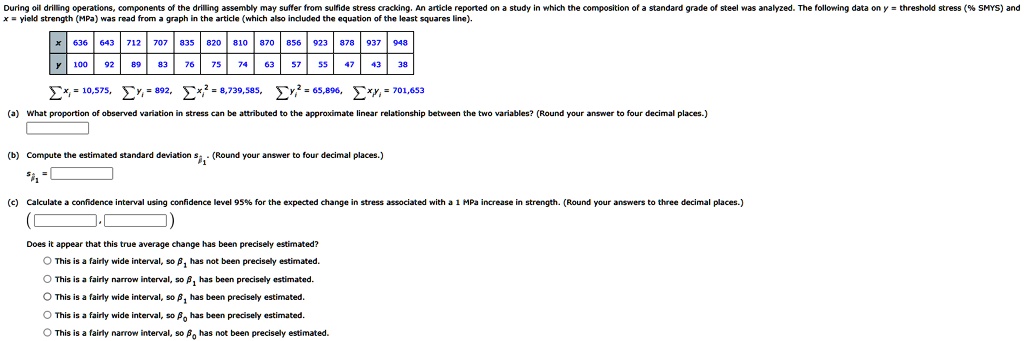
During oil drilling operations, components of the drilling assembly may suffer from sulfide stress cracking. An article reported on a study in which the composition of a standard grade of steel was analyzed. The following data on y = threshold stress (% SMYS) and x = yield strength (MPa) was read from a graph in the article (which also included the equation of the least squares line).
\begin{tabular}{|c|c|c|c|c|c|c|c|c|c|c|c|}
\hline
x & 636 & 643 & 712 & 707 & 835 & 820 & 810 & 870 & 856 & 923 & 878 & 937 & 948 \\
\hline
y & 100 & 92 & 89 & 83 & 76 & 75 & 74 & 63 & 57 & 55 & 47 & 43 & 38 \\
\hline
\end{tabular}
$\sum x_i = 10,575$, $\sum y_i = 892$, $\sum x_i^2 = 8,739,585$, $\sum y_i^2 = 65,896$, $\sum x_i y_i = 701,653$
(a) What proportion of observed variation in stress can be attributed to the approximate linear relationship between the two variables? (Round your answer to four decimal places.)
(b) Compute the estimated standard deviation $s_{\beta_1}$. (Round your answer to four decimal places.)
$s_{\beta_1} = \text{________}$
(c) Calculate a confidence interval using confidence level 95% for the expected change in stress associated with a 1 MPa increase in strength. (Round your answers to three decimal places.)
$(\text{________}, \text{________})$
Does it appear that this true average change has been precisely estimated?
$\bigcirc$ This is a fairly wide interval, so $\beta_1$ has not been precisely estimated.
$\bigcirc$ This is a fairly narrow interval, so $\beta_1$ has been precisely estimated.
$\bigcirc$ This is a fairly wide interval, so $\beta_1$ has been precisely estimated.
$\bigcirc$ This is a fairly wide interval, so $\beta_0$ has been precisely estimated.
$\bigcirc$ This is a fairly narrow interval, so $\beta_0$ has not been precisely estimated.