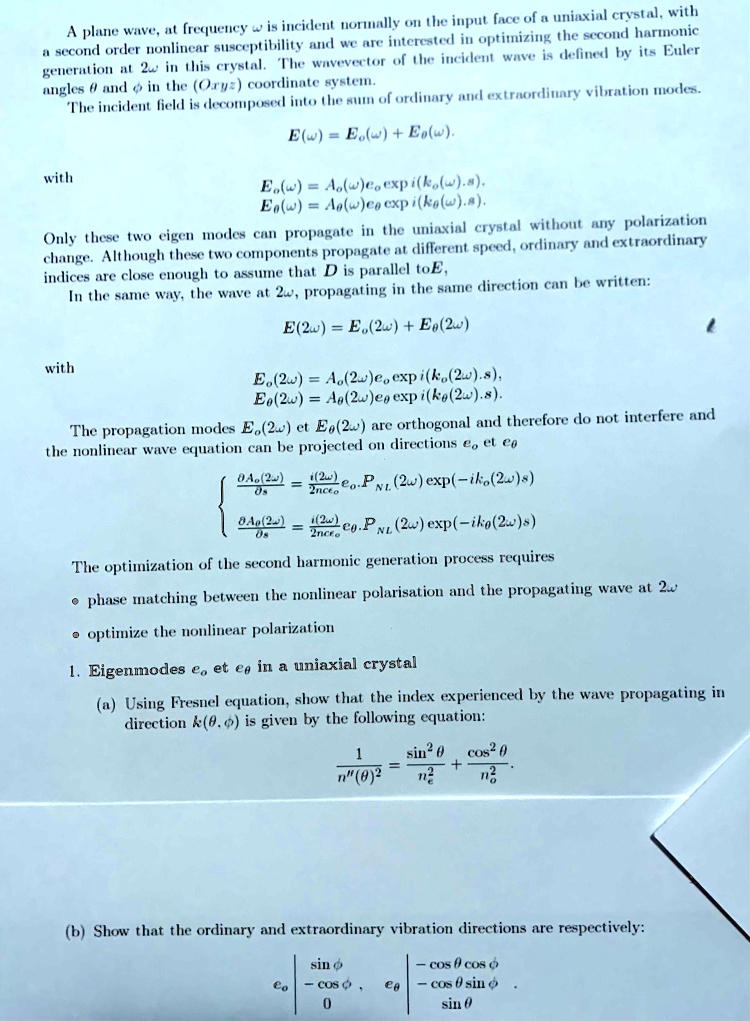
A plane wave, at frequency ω is incident normally on the input face of a uniaxial crystal, with a second-order nonlinear susceptibility, and we are interested in optimizing the second harmonic generation at 2ω in this crystal. The wavevector of the incident wave is defined by its Euler angles θ and φ in the (Oxyz) coordinate system. The incident field is decomposed into the sum of ordinary and extraordinary vibration modes. E(ω) = Eo(ω) + Eθ(ω), with Eo(ω) = Ao(ω)eo exp(iko(ω)s) and Eθ(ω) = Aθ(ω)eθ exp(ikθ(ω)s). Only these two eigenmodes can propagate in the uniaxial crystal without any polarization change. Although these two components propagate at different speeds, ordinary and extraordinary indices are close enough to assume that D is parallel to E. In the same way, the wave at 2ω, propagating in the same direction can be written: E(2ω) = Eo(2ω) + Eθ(2ω) with Eo(2ω) = Ao(2ω)eo exp(iko(2ω)s) and Eθ(2ω) = Aθ(2ω)eθ exp(ikθ(2ω)s). The propagation modes Eo(2ω) and Eθ(2ω) are orthogonal and therefore do not interfere, and the nonlinear wave equation can be projected on directions eo and eθ. (∂Ao(2ω))/(∂s) = (i(2ω))/(2ncεo)eο*PNL(2ω)exp(-iko(2ω)s) (∂Aθ(2ω))/(∂s) = (i(2ω))/(2ncεo)eθ*PNL(2ω)exp(-ikθ(2ω)s). The optimization of the second harmonic generation process requires phase matching between the nonlinear polarization and the propagating wave at 2ω, optimize the nonlinear polarization. Eigenmodes eo and eθ in a uniaxial crystal (a) Using Fresnel equation, show that the index experienced by the wave propagating in direction k(θ, φ) is given by the following equation: (1)/(n''(θ)^(2)) = (sin^(2)θ)/(ne^(2)) + (cos^(2)θ)/(no^(2)). (b) Show that the ordinary and extraordinary vibration directions are respectively: εo|[sinφ], [-cosφ], [0], eθ|{(:[-cosθcosφ]), (-cosθsinφ), (sinθ):}.