Problem 4 (21 pts)
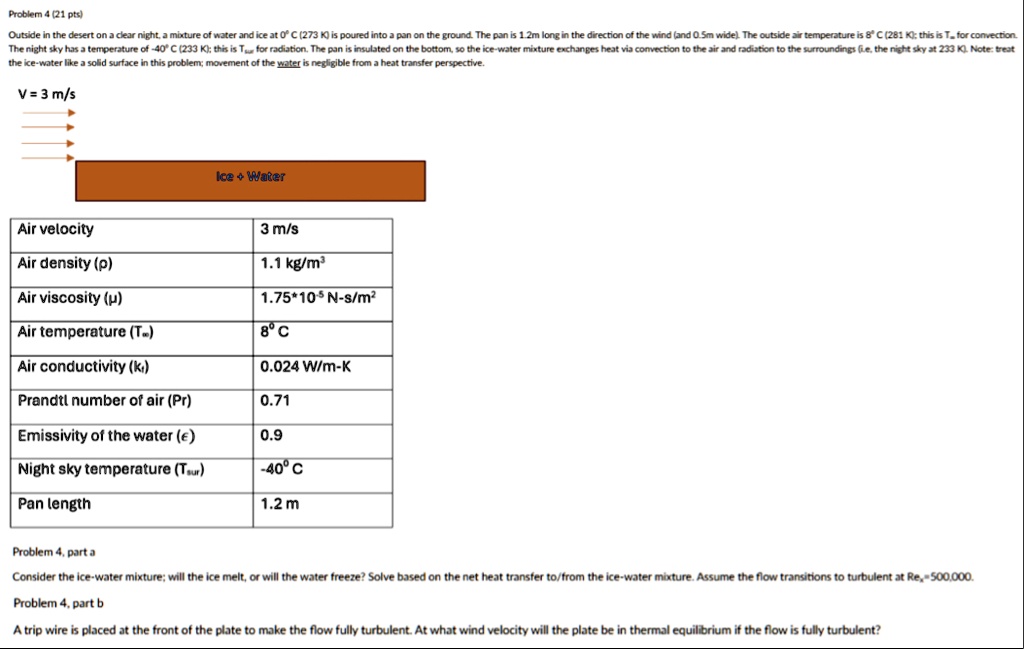
Outside in the desert on a clear night, a mixture of water and ice at $0^\circ C$ (273 K) is poured into a pan on the ground. The pan is 1.2m long in the direction of the wind (and 0.5m wide). The outside air temperature is $8^\circ C$ (281 K); this is $T_\infty$ for convection.
The night sky has a temperature of $-40^\circ C$ (233 K); this is $T_{sur}$ for radiation. The pan is insulated on the bottom, so the ice-water mixture exchanges heat via convection to the air and radiation to the surroundings (i.e., the night sky at 233 K). Note: treat
the ice-water like a solid surface in this problem; movement of the water is negligible from a heat transfer perspective.
V = 3 m/s
Ice + Water
Air velocity
3 m/s
Air density ($\rho$)
1.1 kg/m$^3$
Air viscosity ($\mu$)
$1.75*10^{-5}$ N-s/m$^2$
Air temperature ($T_\infty$)
$8^\circ C$
Air conductivity ($k_f$)
0.024 W/m-K
Prandtl number of air (Pr)
0.71
Emissivity of the water ($\epsilon$)
0.9
Night sky temperature ($T_{sur}$)
$-40^\circ C$
Pan length
1.2 m
Problem 4, part a
Consider the ice-water mixture; will the ice melt, or will the water freeze? Solve based on the net heat transfer to/from the ice-water mixture. Assume the flow transitions to turbulent at $Re_x=500,000$.
Problem 4, part b
A trip wire is placed at the front of the plate to make the flow fully turbulent. At what wind velocity will the plate be in thermal equilibrium if the flow is fully turbulent?