Text: Advanced Thermodynamics
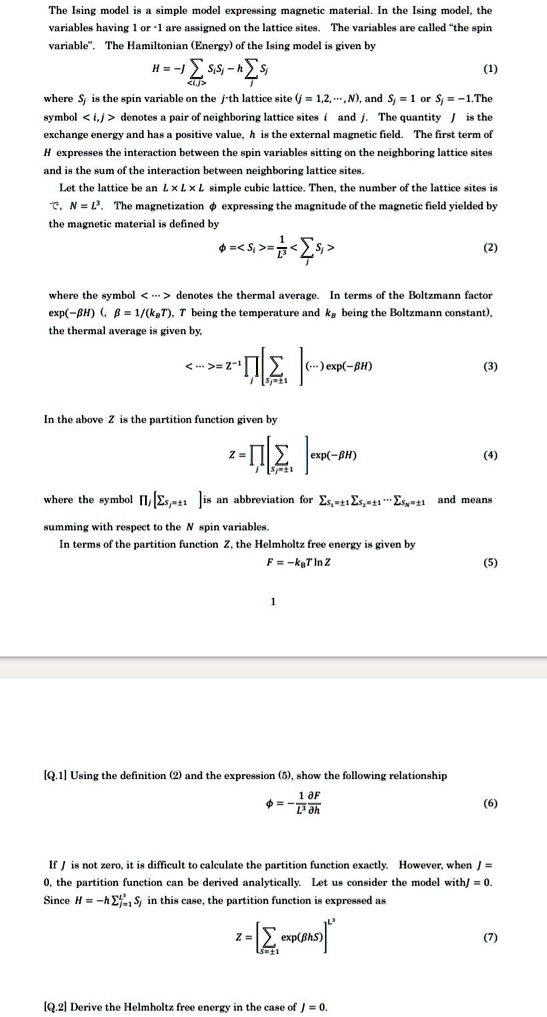
The Ising model is a simple model for expressing magnetic materials. In the Ising model, variables with values of 1 or -1 are assigned to the lattice sites. These variables are called spin variables. The Hamiltonian (Energy of the Ising model) is given by H = -ΣsS - hs (1), where S is the spin variable on the j-th lattice site (j = 1, 2, N) and S = 1 or S = -1. The symbol <i> denotes a pair of neighboring lattice sites i and j. The quantity J is the exchange energy and has a positive value, h is the external magnetic field. The first term of H expresses the interaction between the spin variables sitting on the neighboring lattice sites and is the sum of the interactions between neighboring lattice sites. Let the lattice be an L x L x L simple cubic lattice. Then, the number of lattice sites is N = L^3. The magnetization, which expresses the magnitude of the magnetic field yielded by the magnetic material, is defined by <s> = (2), where the symbol <> denotes the thermal average. In terms of the Boltzmann factor exp(-H/kT), where T is the temperature and k is the Boltzmann constant, the thermal average is given by <s> = Σ(exp(-H)). In the above equation, Z is the partition function given by Z = Σ(exp(-H)). In terms of the partition function Z, the Helmholtz free energy is given by F = -kT ln(Z) (5).
[Q.1] Using the definition (2) and the expression (5), show the following relationship: 1F = <s>h (6).
If J is not zero, it is difficult to calculate the partition function exactly. However, when J = 0, the partition function can be derived analytically. Let us consider the model with J = 0. Since H = -hΣS in this case, the partition function is expressed as exp(hΣS) (C).
[Q.2] Derive the Helmholtz free energy in the case of J = 0.