Ace - AI Tutor
Ask Our Educators
Textbooks
My Library
Flashcards
Scribe - AI Notes
Notes & Exams
Download App
erin green

erin g.

Divider

Questions asked

BEST MATCH

A gene in which the heterozygous condition is displayed differently in males and females is referred to as ◻ sex-limited X -finded sex-influenced temprinting

View Answer
divider
BEST MATCH

Part A If an amount of heat Q is needed to increase the temperature of a solid metal sphere of diameter D from 3°C to 9°C, the amount of heat needed to increase the temperature of a solid sphere of diameter 3D of the same metal from 3°C to 9°C is O Q. O 3Q. ○ 9Q. O 27Q. Submit Request Answer

View Answer
divider
BEST MATCH

For the following normal logic program P, find the sets of completion nogoods $\Delta_P$ and the loop nogoods $\Lambda_P$. a ← c ← ¬b, ¬d d ← a, ¬c How many nogoods contains $\Delta_P$?

View Answer
divider
BEST MATCH

2B. (ii) What volume of donor blood (in liters) would be required to raise the hemoglobin level of a sickle cell patient from 8 g/dL to 10 g/dL? Assume the following and state any additional assumptions: • A single bag of blood contains approximately 200 mL of red blood cells, which account for 60% of the volume of blood. • A hemoglobin increase of 1 g/dL is achieved by transfusing approximately 0.01 bags of blood per kilogram of body weight. 4

View Answer
divider
BEST MATCH

Find \iint_R (3x + 5y)dA where R is the parallelogram with vertices (0,0), (-2,-4), (3,-3), and (1,-7). Use the transformation x = -2u + 3v, y = -4u - 3v

View Answer
divider
BEST MATCH

B.Requiring the verification of a user's identity when using a digital wallet provides better protection for the user against theft (Lambarena 2021).

View Answer
divider
BEST MATCH

(a) What is the rate of change of f(x, y) = 2xy + y² at the point (3, 3) in the direction \vec{v} = 2\hat{i} + 2\hat{j}? (b) What is the direction of maximum rate of change of f at (3, 3)? direction = <\frac{\sqrt{5}}{5}, \frac{2\sqrt{5}}{5}> (Give your answer as a vector.) (c) What is the maximum rate of change?

View Answer
divider
BEST MATCH

As an engineering technician in a company you are asked to determine if already installed motor can lift gravitational type of load of 92 Nm. An already installed, three phase induction motor, is 6 pole, 15 kW output power, 415 V, operating at 50 Hz with nominal speed 960 RPM. Motor's efficiency is 82% and power factor is 0.86. Manufacturer has supplied following data: Ratio: Locked rotor (starting) torque / Nominal torque= 2.4 Ratio: Breakdown (maximum) torque) / Nominal torque=2.8 Ratio: Starting (locked rotor) current / Nominal current = 6 Calculate: a. Input power b. Full load current c. Starting current d. Slip% e. Full load torque f. Starting (Locked Rotor) torque g. Maximum (Breakdown) torque h. Draw typical speed/torque characteristic and show calculated parameters i. If the motor is supposed to lift the load of 92 Nm for very short period will the motor be able to start. Explain the answer and support it with the aid of speed/torque diagram.

View Answer
divider
BEST MATCH

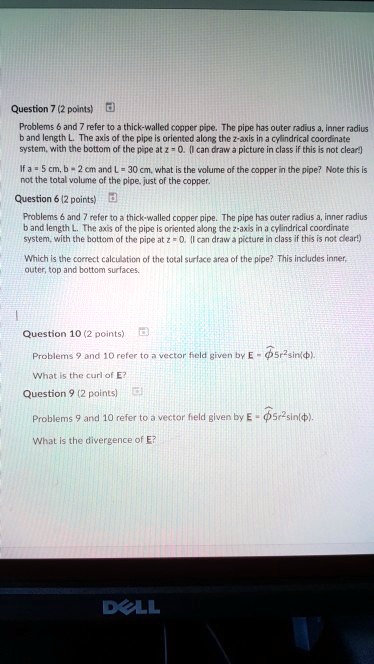
Question 7 (2 points) Problems 6 and 7 refer to a thick-walled copper pipe. The pipe has outer radius a, inner radius b and length L. The axis of the pipe is oriented along the z-axis in a cylindrical coordinate system, with the bottom of the pipe at z = 0. (I can draw a picture in class if this is not clear!) If a = 5 cm, b = 2 cm and L = 30 cm, what is the volume of the copper in the pipe? Note this is not the total volume of the pipe, just of the copper. Question 6 (2 points) Problems 6 and 7 refer to a thick-walled copper pipe. The pipe has outer radius a, inner radius b and length L. The axis of the pipe is oriented along the z-axis in a cylindrical coordinate system, with the bottom of the pipe at z = 0. (I can draw a picture in class if this is not clear!) Which is the correct calculation of the total surface area of the pipe? This includes inner, outer, top and bottom surfaces. Question 10 (2 points) Problems 9 and 10 refer to a vector field given by \(\vec{E} = \phi 5r^2 \sin(\phi)\). What is the curl of \(\vec{E}\)? Question 9 (2 points) Problems 9 and 10 refer to a vector field given by \(\vec{E} = \phi 5r^2 \sin(\phi)\). What is the divergence of \(\vec{E}\)?
View Answer
divider
BEST MATCH

16.49 a) Make an amplitude and phase plot, based on Eq. 16.20, for the periodic voltage in Example 16.3. Assume $V_m$ is 40 V. Plot both amplitude and phase versus $n\omega_o$, where $n$ = 0, 1, 2, 3, ... b) Repeat (a), but base the plots on Eq. 16.32.

View Answer
divider