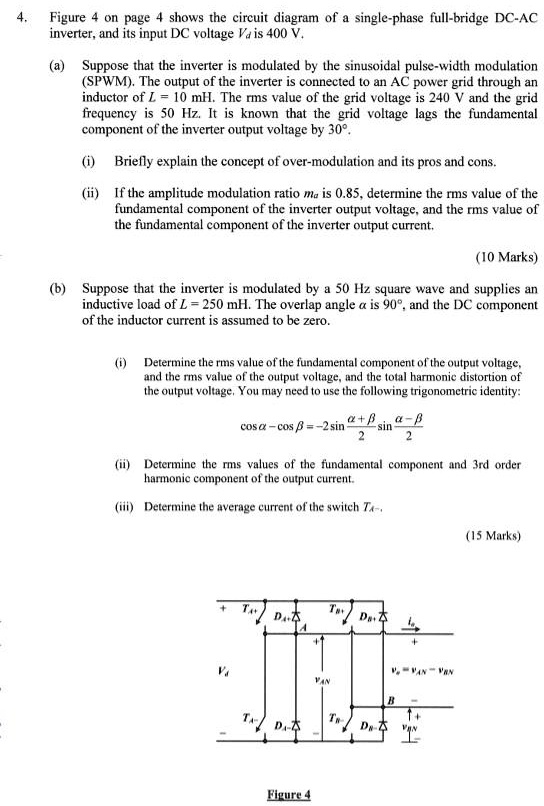
Figure 4 on page 4 shows the circuit diagram of a single-phase full-bridge DC-AC inverter, and its input DC voltage Va is 400 V.
(a)
Suppose that the inverter is modulated by the sinusoidal pulse-width modulation (SPWM). The output of the inverter is connected to an AC power grid through an inductor of L = 10 mH. The rms value of the grid voltage is 240 V and the grid frequency is 50 Hz. It is known that the grid voltage lags the fundamental component of the inverter output voltage by 30 degrees.
(i)
Briefly explain the concept of over-modulation and its pros and cons.
(ii) If the amplitude modulation ratio (ma) is 0.85, determine the rms value of the fundamental component of the inverter output voltage and the rms value of the fundamental component of the inverter output current.
(10 Marks)
(b) Suppose that the inverter is modulated by a 50 Hz square wave and supplies an inductive load of L = 250 mH. The overlap angle is 90 degrees, and the DC component of the inductor current is assumed to be zero.
(i) Determine the rms value of the fundamental component of the output voltage and the rms value of the output voltage, and the total harmonic distortion of the output voltage. You may need to use the following trigonometric identity:
2
2
(ii) Determine the rms values of the fundamental component and 3rd order harmonic component of the output current.
(iii) Determine the average current of the switch T-V.
V = YANVBN
VAN
R t+
D
Figure 4