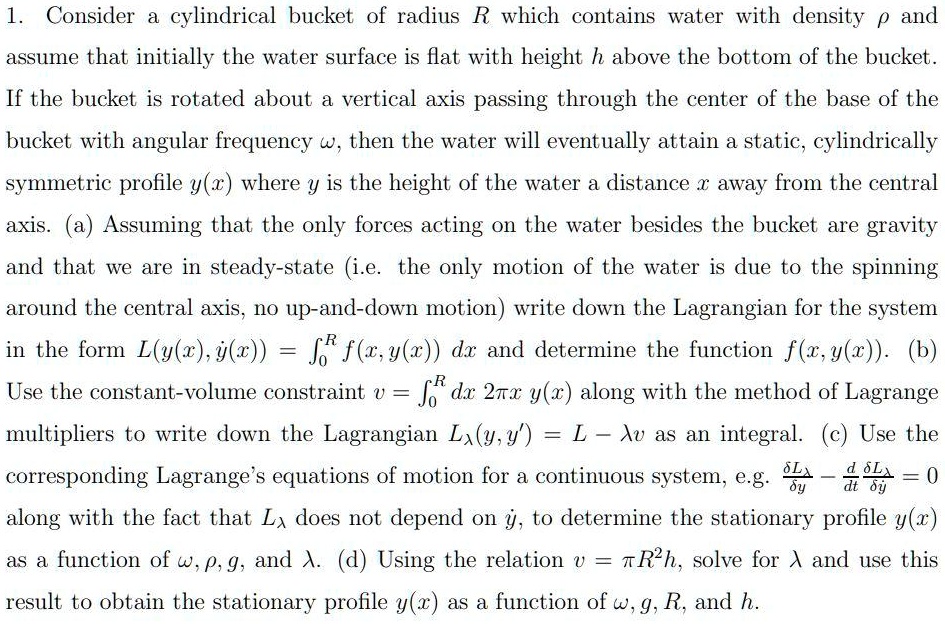
Consider a cylindrical bucket of radius R which contains water with density p. Assume that initially the water surface is flat with height h above the bottom of the bucket. If the bucket is rotated about a vertical axis passing through the center of the base of the bucket with angular frequency w, then the water will eventually attain a static, cylindrically symmetric profile y, where y is the height of the water at a distance away from the central axis.
a. Assuming that the only forces acting on the water besides the bucket are gravity and that we are in a steady-state (i.e. the only motion of the water is due to the spinning around the central axis, no up-and-down motion), write down the Lagrangian for the system in the form L(y,x,y',x') = f(x,y,x',y') dx and determine the function f(x,y).
b. Use the constant-volume constraint u = f(x) dx^2 + Txy(x) along with the method of Lagrange multipliers to write down the Lagrangian L(y,u) = L - Au as an integral.
c. Use the equation Lx = L = 0 along with the fact that L does not depend on y, to determine the stationary profile y as a function of w, g, and X.
d. Using the relation X = TRh, solve for X and use this result to obtain the stationary profile y(x) as a function of w, g, R, and h.