Questions asked
What is meant by a school of psychology? Is there a particular school that interests you? How is it different from other schools of psychology?
It is known that 10% of the microwaves shipped from a particular factory are defective. What is the probability that at least one in a random sample of four microwaves is defective?
Find the following probabilities based on the standard normal variable Z. (You may find it useful to referen answers to 4 decimal places.) a. $P(-0.87 \le Z \le -0.57)$ b. $P(0.02 \le Z \le 2.31)$ c. $P(-1.6 \le Z \le 0.17)$ d. $P(Z > 4.3)$
Lysosomes not only digest microbes but also are involved in the process of \"cell suicide\" called apoptosis. Question 14 Not yet answered Marked out of 1.00 Select one: a. True b. False
1) P = $7996; r = 6%; t = 10 months. Find A. A) $6663.33 B) $399.80 C) $8395.80 D) $8475.76 2) Allan borrowed $3900 from his father to buy a car. He repaid him after 6 months with interest of 12º total amount he repaid. A) $234.00 B) $4368.00 C) $4134.00 D) $4095.00
From the article by Landon Webb, describe how people with disabilities are portrayed.
Discussion questions: 1. Define "rationality" and comment on the key problem with the models used in the field of economics. 2. Discuss an example from Dan Ariely's video that surprised you and provide an answer to the following question: "are we in control of our decisions?" 3. How does Richard Thaler plan to spend his Nobel Peace Prize money (from the article above and what do you think he meant by this response? 4. Give an example of a time when you behaved "irrationally" and how that might have distorted an "optimal" or "economic" outcome.
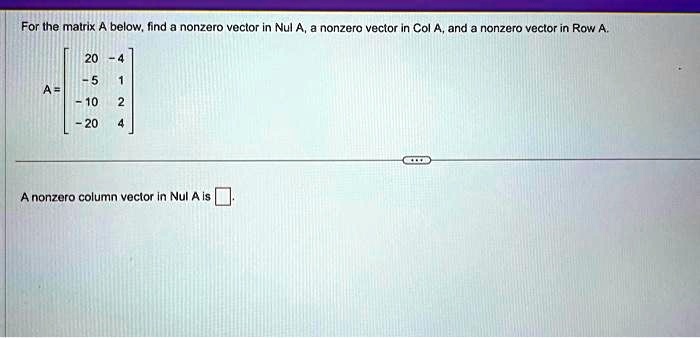
For the matrix A below, find a nonzero vector in Nul A, a nonzero vector in Col A, and a nonzero vector in Row A.\\ \begin{bmatrix} 20 & -4 \\ -5 & 1 \\ -10 & 2 \\ -20 & 4 \end{bmatrix}\\ A nonzero column vector in Nul A is
3. Which of the following reactions shows acetic acid, a common weak acid, reacting with water? a. CH$_3$COOH(aq) + H$_2$O(l) ? H$_3$O$^+$ (aq) + CH$_3$COO$^-$ (aq) CH$_3$COOH(aq) + H$_2$O(l) $\stackrel{>99\%}{\longrightarrow}$ H$_3$O$^+$ (aq) + CH$_3$COO$^-$ (aq) CH$_3$COOH(aq) + H$_2$O(l) $\stackrel{>50\%}{\longrightarrow}$ H$_3$O$^+$ (aq) + CH$_3$COO$^-$ (aq) CH$_3$COOH(aq) + H$_2$O(l) $\stackrel{<50\%}{\longrightarrow}$ H$_3$O$^+$ (aq) + CH$_3$COO$^-$ (aq)
PROBLEM (3) (25 points) Two very long conducting cylinders of radii R are aligned parallel with a separation d between their axes. The cylinder on the left is hollow and carries a charge per unit length $-\lambda$, while the (solid) cylinder on the right has charge per unit length $3\lambda$. Express your answers in terms of some or all of the given quantities and appropriate constants, as needed. (a) (6 pts) Using Gauss's law find the electric field at a point P which is at a distance x from the axis of the cylinder on the left. Express your answer in terms of unit vectors.