Questions asked
The monthly payment on a four-year car loan is given by $M = \frac{25000r(1+r)^{48}}{(1+r)^{48}-1}$ dollars where r is the interest rate as a decimal (so 4.5% would be represented by r = 0.045). If you can afford a monthly payment of $680, what interest rate must you get. Report your answer as the actual interest rate (not as a decimal) rounded to 2 places.
4:46 PM Fri Aug 30 VPN \( 100 \% \) \( A A \) bigideasmath.com Pioneer Middle... 8/30 FINAL Cult... Lesson B. 3 pt. \( 2 . \). How to Open a C... Dashboard Assignment Pla... BIG IDEAS MATH Maria Lee \#9 i Save / Exit Listen You spin the spinner and flip a coin. Find the probability of the compound event. The probability of spinning a number less than 3 and flipping tails is \( \square \) . Previous 4 5 6 7 8 9 10 11 12 13 Next Live Tutor
Setup, but do not evaluate, find the work required to pump all water out of a cylinder that has a circular base of radius 4 ft and height 120 ft, use the fact that the density of water is 62.5 lb/ft^3
How do neuroblasts migrate in the direction of the pia from the ventricular zone?
Texts: A particle moves according to a law of motion below, 0 ≤ t < 4, where t is measured in seconds and s in feet. s = f(t) = cos((πt)/2) a) Find the total distance traveled during the first 4 s. b) Find the acceleration at time t and after 3 s. (Round your answer to three decimal places.) c) When is the particle speeding up? (0 ≤ t ≤ 4) d) When is it slowing down?
A single loop of nickel wire, lying flat in a plane, induced current (in mA) in the loop of wire over that mA.
1. Consider the first order system of ODEs: $x_1' = x_2$ $x_2' = x_3$ $x_3' = 1 + x_1 + 2x_2 + 3x_3$, where $x_1(0) = 1$ $x_2(0) = -1$ $x_3(0) = 2$ Write the system as a single higher order ODE with right hand side constant and appropriate initial conditions. 2. Part a. Adapt Euler's Method to solve for $y(2)$ and $y'(2)$ where the step size $h = 1$ for the ODE modeling a forced mass-spring system $y'' + 3y' + 2y = sin(\frac{\pi}{2})$ where $y(0) = 1$ and $y'(0) = 0$. (Solve for $y(2)$ and $y'(2)$). Part b. Use the second order RK method (the midpoint method, appropriately modified for the system) given by: $v_1 = hf(x, y)$ $v_2 = hf(x + \frac{h}{2}, y + \frac{1}{2}v_1)$ $y_{i+1} = y_i + v_2$ to approximate $y(2)$ and $y'(2)$ where the step size is 2. Part c. Use the fourth order RK method (appropriately modified for the system) to approximate $y(2)$ where the step size is 2.
VI. Scientific Method Review Questions. 1. Identify the steps of the ideal scientific method. 2. Describe the circumstances where a correlation study might be necessary. 3. Explain what a controlled experiment is. Why are controls so important? 4. What should you (as a scientist) do when evidence disproves your hypothesis?
5. [10 pts.] Suppose that Bob receives a PGP message from Alice. How does Bob know for sure that Alice created the message (rather than, say, Trudy)? Does PGP use a MAC for message integrity?
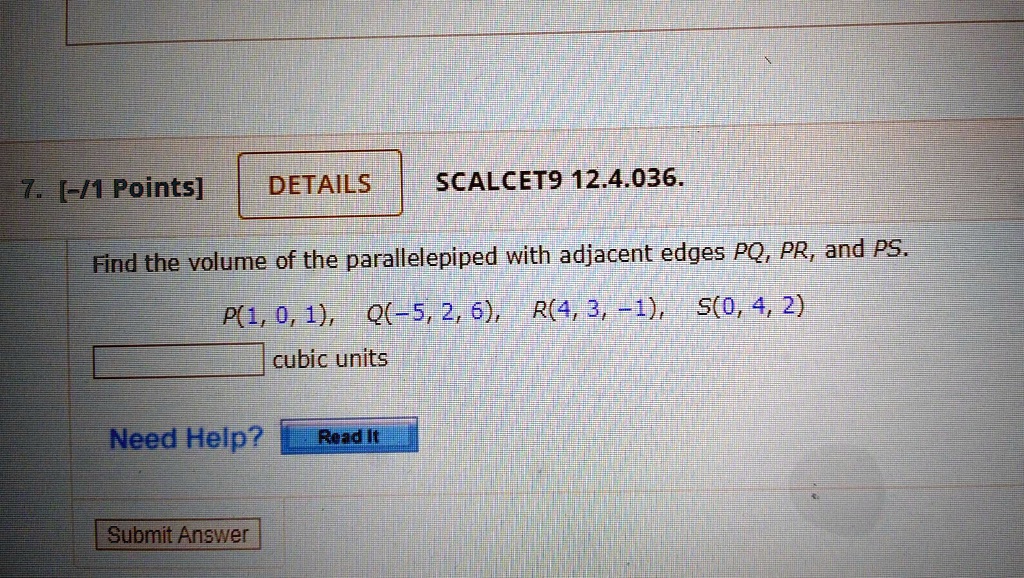
7. [-/1 Points] DETAILS SCALCET9 12.4.036. Find the volume of the parallelepiped with adjacent edges PQ, PR, and PS. P(1, 0, 1), Q(-5, 2, 6), R(4, 3, -1), S(0, 4, 2) cubic units Need Help? Read It Submit Answer