Ace - AI Tutor
Ask Our Educators
Textbooks
My Library
Flashcards
Scribe - AI Notes
Notes & Exams
Download App
erin santamaria

erin s.

Divider

Questions asked

BEST MATCH

A r B P L_A C L_B D T What is the smallest diameter of the solid shaft (A thru D) if the allowable shear stress in the shaft is 59 MPa. The radius of disk B is r = 83 mm, the length of shaft L_A = L_B = 146 mm and the applied torque T = 610 N·m. The shaft is in equilibrium and is not moving. The answer should be in mm with 1 digit of accuracy.

View Answer
divider
BEST MATCH

20 Multiple Choice 2 points The Q-T interval corresponds to which event(s)? Atrial depolarization and repolarization Ventricular depolarization and repolarization Ventricular repolarization only Ventricular depolarization only ing 2 hours Search

View Answer
divider
BEST MATCH

2. (5 marks) A new fibre optic cable line must connect from a substation on shore to an offshore oil rig. The cost of laying fibre optic cable underwater is twice the cost of laying it underground. The oil rig is located at a point O that is exactly 5 km due north of a point P on shore, and the substation S is located on shore exactly 11 km due west of P. Determine the plan for laying the fibre optic cable that minimizes the overall cost. 3. (5 marks, 2.5 each) Evaluate the following limits:

View Answer
divider
BEST MATCH

That neonates can discriminate and imitate facial expressions assists in social interaction. cognitive development. motor coordination. mood congruent growth.

View Answer
divider
BEST MATCH

Responsibility accounting systems strive to: Multiple Choice place blame on guilty individuals. provide information to managers. hold managers accountable for both controllable and noncontrollable costs. identify unfavorable variances. provide information so that managers can make decisions that are in the best interest of their individual centers rather than in the best interests of the firm.

View Answer
divider
BEST MATCH

A patient with presbycusis is fitted with binaural hearing aids. Which information will the nurse include when teaching the patient how to use the hearing aids? Keep the volume low on the hearing aids for the first week Experiment with volume and hearing in a quiet environment Add the second hearing aid after making adjustments to the first hearing aid Begin wearing the hearing aids for an hour a day, gradually increasing the use

View Answer
divider
BEST MATCH

Write an equation of the line satisfying the given conditions. Write the answer in slope-intercept form. 3 The line passes through the point (-4, 10) and has a slope of -\frac{3}{2}. 3 y = -\frac{3}{2}x + 16 3 y = -\frac{3}{2}x + 4 3 y = \frac{3}{2}x + 4 3 y = -\frac{3}{2}x - 4

View Answer
divider
BEST MATCH

(10 points) Consider the following state table State X=0 X=1 Output SO S3 S1 0 S1 S3 S1 0 S2 S1 S5 0 S3 S2 S6 0 S4 S5 S4 1 S5 S3 S2 1 S6 S3 S4 0 Table 1: Caption (a) Using the above state table, group the states by the three assignment guidelines given in the slides (b) Using the assignment groupings in part a, create a 3-bit state assignment map and determine optimal state assignments. How many groupings can be satisfied? How many cannot?

View Answer
divider
BEST MATCH

A sample of bacteria in a laboratory is growing at a rate of 6% per day. In the answer box below, answer each of these questions. Please label them as a, b, and c as you answer them. (3 pts) a. Write an exponential model for the growth. (Use the answer box below to type your answer) (3 pts) b. In your model, explain what the input variable represents. (Use the answer box below to type your answer as a complete sentence) (4 pts) c. Use your model to find when there will be twice as much bacteria. Round to the nearest whole day. (Write answer in the box below and show all algebraic work on your paper.)

View Answer
divider
BEST MATCH

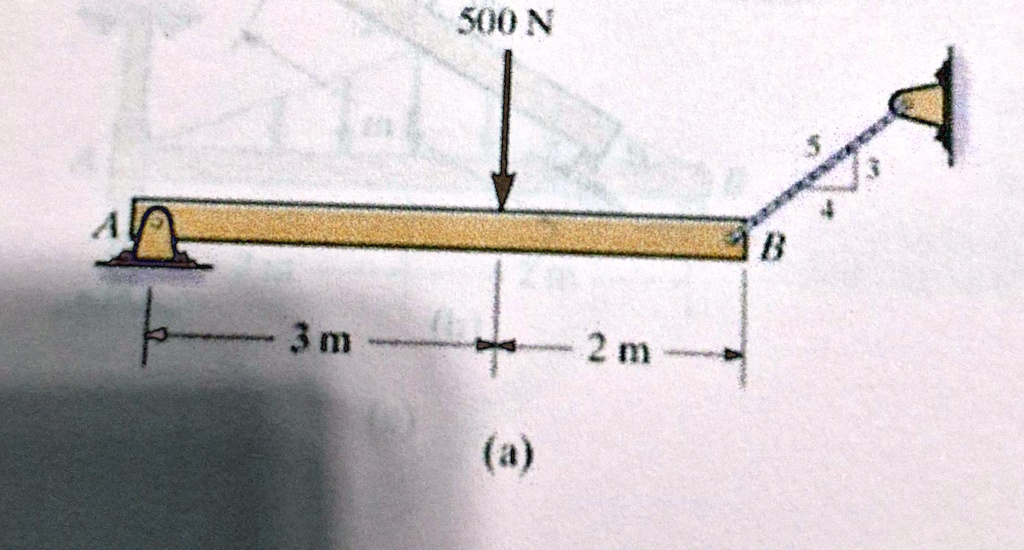
500 N \begin{tikzpicture} \draw (0,0) -- (5,0); \draw (0,0) -- (0,-0.2); \draw (5,0) -- (5,-0.2); \draw (0,0) node[left] {A}; \draw (5,0) node[right] {B}; \draw (2.5,0.5) -- (2.5,1); \draw (2.5,1) node[above] {500 N}; \draw (0,-0.5) -- (3,-0.5); \draw (3,-0.5) -- (3,-0.7); \draw (3,-0.5) node[below] {3 m}; \draw (3,-0.5) -- (5,-0.5); \draw (5,-0.5) -- (5,-0.7); \draw (5,-0.5) node[below] {2 m}; \draw (5,0) -- (6,1); \draw (6,1) -- (6.2,1.2); \draw (6.2,1.2) -- (6.2,1); \draw (6,1) -- (6.2,0.8); \draw (6.2,0.8) -- (6,1); \draw (5.5,0.5) node[above] {5}; \draw (5.8,0.2) node[right] {3}; \draw (5.5,0.2) node[right] {4}; \end{tikzpicture} (a)
View Answer
divider