Ace - AI Tutor
Ask Our Educators
Textbooks
My Library
Flashcards
Scribe - AI Notes
Notes & Exams
Download App
ernest s-enz

ernest s.

Divider

Questions asked

BEST MATCH

Which of the following statements about acclimation is true? Group of answer choices The response of a plant that enhances its survival and reproduction by changing the genetic code is called acclimation Acclimation is the change in a plant population in response to repeated exposure to a specific stress Acclimation represents a non-permanent change of a plant that can be reversed if the environmental conditions that lead to it change Acclimation represents a permanent change of a plant that cannot be reversed if the environmental conditions that lead to it change

View Answer
divider
BEST MATCH

A client has a prescription for blood pressure (BP) measurements every fifteen minutes. The unlicensed assistive personnel (UAP) applied the cuff of an electronic blood pressure machine to the client's upper arm during the first BP measurement. Which instruction should the nurse provide the UAP? A Record each BP measurement on a flow sheet. B Remove the cuff between each BP measurement. C Keep the machine unplugged between readings. D Measure the BP manually instead of electronically.

View Answer
divider
BEST MATCH

Jose and his friends went to the planetarium during the day, and when they initially walked into the dark room, they were unable to see the chairs and walking pathways. After a few minutes, they were able to see the details in the room. This adjustment is called dark adaptation.

View Answer
divider
BEST MATCH

4. What is true concerning a cube shaped Gaussian surface to the right of the +Q point charge and any associated electric fields and electric flux? How would this change if the charge was inside the Gaussian surface? +Q 5. Three conducting spheres are on the ends of perfectly insulating strings. Object A has a charge of +8.0µC, object B has a charge of -12.0µC, and object C is uncharged. The three charged objects interact and exchange charge with each other and no other object or objects. After the interaction, the charge on object C is now -2.0µC and the charge on object B is -4.0µC. What is the charge on Object A after the interaction? 6. An electric field is shown below and to the right. Answer the following questions (a) Is the field uniform? How can you tell? (b) Which way would a positively charged particle be pushed? (c) Which way would a negatively charged particle be pushed? 7. Which of the following is correct? (a) For macroscopic objects, the amount of electric charge is based upon the transfer of electrons (from one object to another). (b) Electric field is a direct measurement of the force on an object. (c) Electric field describes the amount of charge located at a location in space. (d) Electric flux through a closed surface is influenced by the amount of charge outside the surface. (e) None of the above is correct.

View Answer
divider
BEST MATCH

If \(\theta\) is an acute angle, solve the equation \(\cos \theta = \frac{\sqrt{3}}{2}\). Express your answer in degrees. Select the correct choice below, and fill in the answer box if necessary. A. \(\theta = \boxed{\text{ }}^\circ\) (Type a whole number. Use a comma to separate answers as needed.) B. There is no solution.

View Answer
divider
BEST MATCH

1. Determine i_o(t) in the network shown below. (15+30u(t)) V 1 ? 4 ? i_o 2 H 1/4 F

View Answer
divider
BEST MATCH

An electron travels through a magnetic field with a strength of 1.80 T and is traveling at a speed of $8.94 \times 10^7$ m/s. What is the z-component of the force on the electron as shown in the figure? z-component: $2.57 \times 10^{-11}$ N

View Answer
divider
BEST MATCH

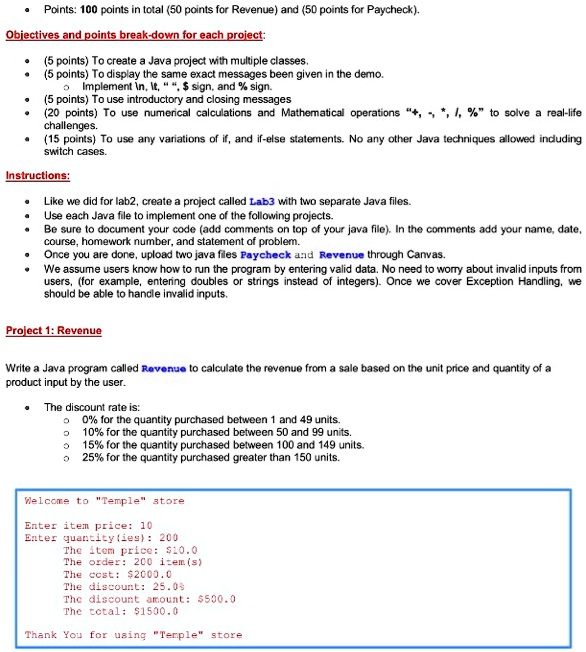
Points: 100 points in total (50 points for Revenue) and (50 points for Paycheck). Objectives and points break-down for each project: : (5 points) To create a Java project with multiple classes. (5 points) To display the same exact messages been given in the demo. Implement in, It, "", $ sign, and % sign. (5 points) To use introductory and closing messages (20 points) To use numerical calculations and Mathematical operations "+, -, *, /, %" to solve a real-life challenges. (15 points) To use any variations of if, and if-else statements. No any other Java techniques allowed including switch cases. Instructions: Like we did for lab2, create a project called Lab3 with two separate Java files. Use each Java file to implement one of the following projects. Be sure to document your code (add comments on top of your java file). In the comments add your name, date, course, homework number, and statement of problem. Once you are done, upload two java files Paycheck and Revenue through Canvas. We assume users know how to run the program by entering valid data. No need to worry about invalid inputs from users, (for example, entering doubles or strings instead of integers). Once we cover Exception Handling, we should be able to handle invalid inputs. Project 1: Revenue Write a Java program called Revenue to calculate the revenue from a sale based on the unit price and quantity of a product input by the user. The discount rate is: 0% for the quantity purchased between 1 and 49 units. 10% for the quantity purchased between 50 and 99 units. 15% for the quantity purchased between 100 and 149 units. 25% for the quantity purchased greater than 150 units. Welcome to "Temple" store Enter item price: 10 Enter quantity (ies): 200 The item price: $10.0 The order: 200 item(s) The cost: $2000.0 The discount: 25.0% The discount amount: $500.0 The total: $1500.0 Thank You for using "Temple" store
View Answer
divider
BEST MATCH

Ba(OH)2(aq) + HNO3(aq) ? Ba(NO3)2 (aq) + H2O (1) Express your answer as a chemical equation. Identify all of the phases in your answer. ??? ? A chemical reaction does not occur for this question. Submit Request Answer ? Part D A Cr2O3(s) + C(s) ? Cr(s) + CO(g) Express your answer as a chemical equation. Identify all of the phases in your answer. ??? ? A chemical reaction does not occur for this question. Submit Request Answer

View Answer
divider
BEST MATCH

It states that if a polynomial P(x) is divided by (x - r), where r is a constant, then the remainder is P (r). * Remainder Theorem Synthetic Division Long Division Factor Theorem

View Answer
divider