Ace - AI Tutor
Ask Our Educators
Textbooks
My Library
Flashcards
Scribe - AI Notes
Notes & Exams
Download App
esperanza henry

esperanza h.

Divider

Questions asked

BEST MATCH

How do you search for a file or folder in Windows?

View Answer
divider
BEST MATCH

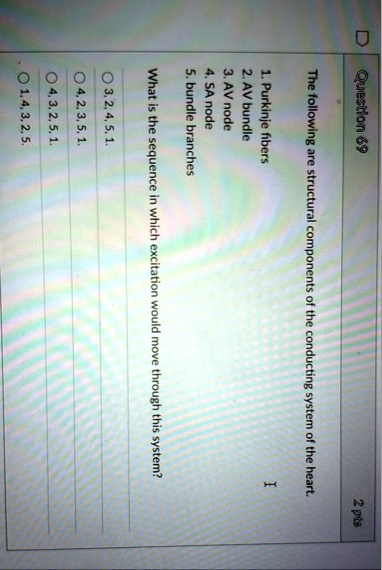
Question 69 2 pts The following are structural components of the conducting system of the heart. 1. Purkinje fibers 2. AV bundle 3. AV node 4. SA node 5. bundle branches What is the sequence in which excitation would move through this system? O 3, 2, 4, 5, 1. O 4, 2, 3, 5, 1. O 4, 3, 2, 5, 1. O 1, 4, 3, 2, 5.
View Answer
divider
BEST MATCH

Range of correlation coefficient Level of correlation 0.80 to 1.00 Very strong positive 0.60 to 0.79 Fairly strong positive 0.40 to 0.59 Moderate positive 0.20 to 0.39 Weak positive 0.00 to 0.19 Very Weak positive -1.00 to -.80 Very strong negative -0.79 to -0.60 Fairly Strong Negative -0.59 to -0.40 Moderate Negative -0.39 to -0.20 Weak Negative -0.19 to -0.01 Very Weak Negative Scenario: Predicting sales based on advertising spend. • Equation: y = 2.5 + 1.3x • (R^2) = 0.85 • (r) = 0.92 There is a Blank 1 (strength) and Blank 2 (direction) relationship between the independent variable Blank 3 and the dependent variable Blank 4. A 1 unit increase in the independent variable Blank 5 results in a Blank 6, Blank 7 (increase or decrease) in the dependent variable Blank 8. Blank 9% of variation in the dependent variable Blank 10 can be explained by the independent variable Blank 11.

View Answer
divider
BEST MATCH

A sofa regularly sells for $660. The sale price is $541.20. Find the percent decrease of the sale price from the regular price.

View Answer
divider
BEST MATCH

Blackboard Remaining Time: 49 minutes, 33 seconds. Question Completion Status: QUESTION 1 1 points Which of the following is true regarding cells in the SA node? A. they undergo regular changes in membrane potential B. they are pacemakers C. they directly trigger contraction of the ventricles D. A and B - they undergo regular changes in membrane potential AND they are pacemakers E. A and B and C - they undergo regular changes in membrane potential AND they are pacemakers AND they directly trigger contraction of the ventricles QUESTION 2 1 points What would happen if you treated a neuron with a drug that blocks voltage-gated K+ channels A. no depolarization at all B. the resting membrane potential would be more positive C. delayed repolarization and no hyperpolarization D. no rapid depolarization E. increased packaging of neurotransmitters per vesicle Blackboard A Remaining Time:49 minutes,33 seconds Question Completion Status: QUESTION1 1 points Save Answer Which of the following is true regarding cells in the SA node? OA.they undergo regular changes in membrane potential OB.they are pacemakers O C.they directly triger contraction of the ventricles O D.A and B - they undergo regular changes in membrane potential AND they are pacemakers O E. A and B and C- they undergo regular changes in membrane potential AND they are pacemakers AND they directly trigger contraction of the ventricles QUESTION2 1 points Save Answer What wouid happen if you treated a neuron with a drug that blocks voltage-gated K+ channels OA.no depolarization at all O B.the resting membrane potential would be more positive O C.delayed repolarization and no hyperpolarization OD.no rapid depolarization OE.increased packaging of neurotransmitters per vesicle

View Answer
divider
BEST MATCH

1) Briefly explain the following questions (in 2-3 sentences). a) Why is dependent variable considered a random variable in simple linear regression? b) What is the difference between Prediction interval and Confidence Interval? c) What is the difference between R$^2$ and Adjusted R$^2$? d) After conducting linear regression, the following residual plots are obtained. Interpret each plot and check the assumptions of linear regression. Determine whether the given model is adequate or not.

View Answer
divider
BEST MATCH

(10%) Problem 2: A particle has charge 0.015 C and mass 4.5 grams. The charge moves from point 1 to point 2. It had kinetic energy 7.59 J at point 1. The voltage (due to other charges) at point 2 is -12 V while that at point 1 is 54 V. Assume non-electric forces are negligible 33% Part (a) What is the change in potential energy as the charge moves from point 1 to point 2? Answer in joules. $\Delta U = -0.99$ $\Delta U = -0.9900 \text{ J}$ Correct! 33% Part (b) What is the kinetic energy of the particle at point 2? Answer in joules.

View Answer
divider
BEST MATCH

An interesting experiment was described in the paper \"Sociochemosensory and Emotional Functions.\" + The authors of this paper wondered if college students could recognize their roommate by scent. They carried out an experiment in which female college students used fragrance-free soap, deodorant, shampoo, and laundry detergent for a period of time. Their bedding was also laundered using a fragrance-free detergent. Each person was then given a new t-shirt that she slept in for one night. The shirt was then collected and sealed in an airtight bag. Later, the roommate was presented with three identical t-shirts (one worn by her roommate and two worn by other women) and asked to pick the one that smelled most like her roommate. (Yes, hard to believe, but people really do research like this!) This process was repeated a second time, with the shirts refolded and rearranged before the second trial. The researchers recorded how many times (0, 1, or 2) that the shirt worn by the roommate was correctly identified. Suppose that instead of three shirts, each participant was asked to choose among four shirts and that the process was repeated five times. Then, assuming that the participant is choosing at random, x = number of correct identifications is a binomial random variable with $n = 5$ and $p = \frac{1}{4}$. USE SALT (a) What are the possible values of x? (Enter your answers as a comma-separated list.) X =

View Answer
divider
BEST MATCH

10 y x -9 -6 -3 3 6 9 -10 Write the standard equation for the hyperbola graphed above.

View Answer
divider
BEST MATCH

Consider four proteins 1, 2, 3, and 4. Protein 1 has 100 amino acids; protein 2 has 250 amino acids; protein 3 has 200 amino acids; protein 4 has 150 amino acids. Each protein has a pI = 6. If a mixture of the four proteins are subjected to electrophoresis followed by staining to detect the proteins, what will be the location of the protein 3 (place the location letter for the corresponding number of the protein in the space provided). The stained gel is at the right with protein marked with positions: 1, 2, 3, 4, protein 1 = protein 2 = protein 3 = protein 4 = 1 2 3 4

View Answer
divider