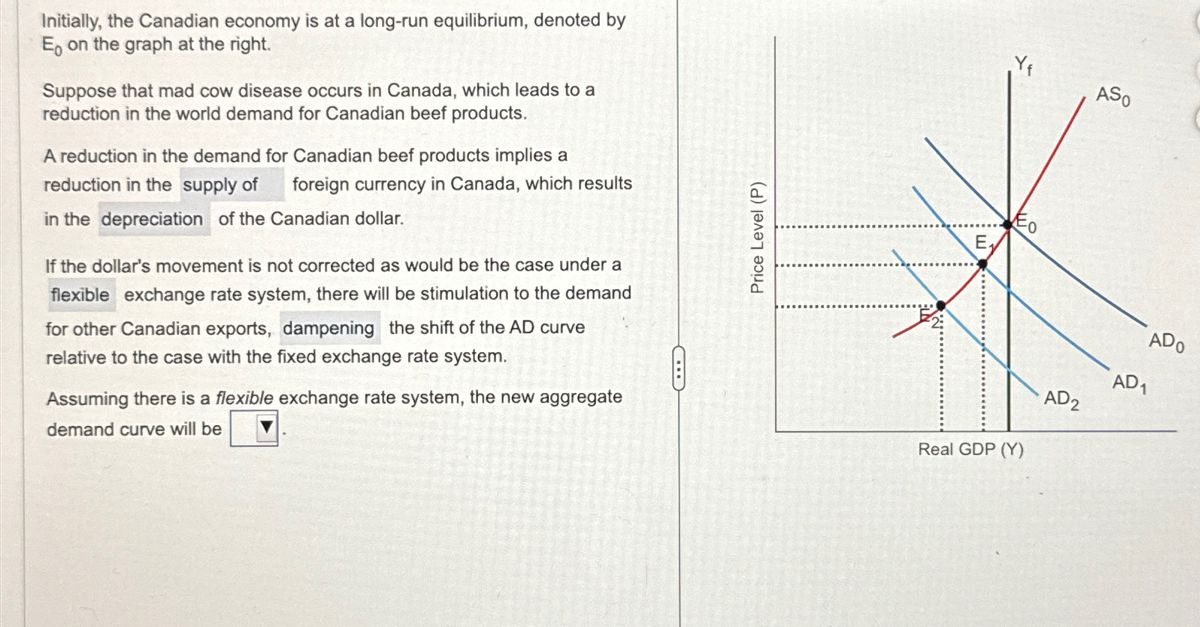
Initially, the Canadian economy is at a long-run equilibrium, denoted by \( E_{0} \) on the graph at the right.
Suppose that mad cow disease occurs in Canada, which leads to a reduction in the world demand for Canadian beef products.
A reduction in the demand for Canadian beef products implies a reduction in the supply of foreign currency in Canada, which results in the depreciation of the Canadian dollar.
If the dollar's movement is not corrected as would be the case under a flexible exchange rate system, there will be stimulation to the demand for other Canadian exports, dampening the shift of the AD curve relative to the case with the fixed exchange rate system.
Assuming there is a flexible exchange rate system, the new aggregate demand curve will be \( \nabla \).