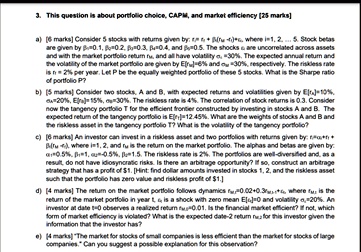
3. This question is about portfolio choice, CAPM, and market efficiency [25 marks]
a) [6 marks] Consider 5 stocks with returns given by: , , + (ru <i)+6, where i1, 2,--. 5. Stock betas are given by ,n0.1, ,n0.2, ,n0.3, ,0.4, and ,n0.5. The shocks 6; are uncorrelated across assets and with the market portfolio return rv.and all have volatility ,=30%. The expected annual return and risk-free rate is n 2% per year. Let P be the equally weighted portfolio of these 5 stocks. What is the Sharpe ratio of portfolio P? %01[]g q ua5 sogsgeo pue srg popodx um.g pue y pogs owopsuo [sr ](q 20%, E[15%, o30%. The risk-free rate is 4%. The correlation of stock returns is 0.3. Consider the excess return of the tangency portfolio iE[.45%. What are the weights of stocks A and B and oego c) [6 marks] An investor can invest in a riskless asset and two portfolios with returns given by: n,*f* q u vs pu sd good g uo g g pue id 0.5%, ,1, cu-0.5%, 1.5. The riskless rate is 2%. The portfolios are well-diversified and, as a result, do not have idiosyncratic risks. Is there an arbitrage opportunity? If so, construct an arbitrage strategy that has a profit of $1. [Hint: find dollar amounts invested in stocks 1, 2, and the riskless asset such that the portfolio has zero value and riskless profit of $1.] d) [4 marks] The return on the market portfolio follows dynamics fg,0.02+0.3rg,*, where fu, is the return of the market portfolio in year t, , is a shock with zero mean E[c0 and volatility o,20%. An investor at date t=0 observes a realized return fuu0.01. Is the financial market efficient? If not, which form of market efficiency is violated? What is the expected date-2 return ne for this investor given the information that the investor has? e [4 marks] The market for stocks of small companies is less efficient than the market for stocks of large ogeqo o uogeux odn no ueedo