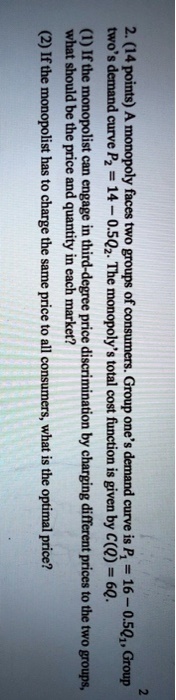
2. (14 points) A monopoly faces two groups of consumers. Group one's demand curve is $P_1 = 16 - 0.5Q_1$, Group two's demand curve $P_2 = 14 - 0.5Q_2$. The monopoly's total cost function is given by $C(Q) = 6Q$.
(1) If the monopolist can engage in third-degree price discrimination by charging different prices to the two groups, what should be the price and quantity in each market?
(2) If the monopolist has to charge the same price to all consumers, what is the optimal price?