Ace - AI Tutor
Ask Our Educators
Textbooks
My Library
Flashcards
Scribe - AI Notes
Notes & Exams
Download App
esther price

esther p.

Divider

Questions asked

BEST MATCH

According to globalization opponents, what has increased in wealthy advanced economies due to outsourcing?

View Answer
divider
BEST MATCH

a studnet was given the following problem. A group od 12012 deer mice ate 66 lb of spilled grain in a day. How much grain did each deer mouse eat that day, on average? The student's work is below

View Answer
divider
BEST MATCH

A property manager who wants to find out if occupancy levels for a give type of property are rising or falling should A) call the local chamber of commerce. B) check with the census bureau. C) survey comparable properties. D) consult the Consumer Price Index (CPI).

View Answer
divider
BEST MATCH

RETINAL DEVELOPMENT AND ITS STRUCTURES The human eye begins to develop at embryonic day (E) 18. The visual groove is formed at E22 before continuing to sag to form the visual vesicle, which expands to form the inner and outer layers of the optic cup. The RPE layer begins to differentiate around E30, with pigment particles found in RPE cells at E35. A set of genes (including PAX6, LHX2, RAX, and SIX3) expressed in the neural plate before E8 are involved in eye determination and eventually form the optic cup (Hoon et al., 2014). In general, vertebrate RPE cells develop and differentiate from optic vesicles. During embryonic development, early optic vesicle cells have bidirectional potential and can develop into the retinal neocortical layer or the RPE layer. The cell fate decision and differentiation of RPE precursor cells is not spontaneous but rather influenced by a variety of microenvironmental factors. Under the influence of extracellular signals, differentiation is guided in strict temporal and spatial order.

View Answer
divider
BEST MATCH

Authoritarian style is most effective in middle and late childhood years

View Answer
divider
BEST MATCH

Based on the given lab procedure, write the balanced reaction equation. (Note: this reaction occurs in steps, which should be shown before combining into one overall reaction equation). Introduction Anhydrous nickel (II) fluoride cannot be prepared by simple means. The direct reaction of the elements gives nickel (III) fluoride and attempts to dehydrate the hydrated salt yield basic compounds due to the similarity in size of the F- and OH- ions. The following indirect method of preparation is typical of the way such problems are overcome. An intermediate is prepared which decomposes on heating to give the desired compound and a variety of volatile by-products. The sequence of reactions will also reveal that not all compounds containing the Ni2+ ion are green. Chemicals required Nickel(II) chloride hexahydrate 6.0 g Concentrated ammonium hydroxide 12 mL Ammonium tetrafluoroborate 5.0 g 6 mol/L ammonium hydroxide 12.5 mL Procedure A: Hexamminonickel(II)tetrafluoroborate Dissolve the nickel(II) chloride hexahydrate in 10 mL of warm deionized water in a 150 mL beaker. In a fumehood, add 12 mL of concentrated ammonium hydroxide to the Ni2+ solution, stirring well while solution and violet colored crystals of hexamminonickel(II) dichloride (these may not be visible). Slowly and carefully, add about 15 mL of water with stirring, to just redissolve these crystals at room temperature. If necessary, filter to remove any residue. Cover the beaker with a watch glass and return it to your bench for the next stage. Dissolve about 5 g of ammonium tetrafluoroborate in about 12.5 mL of 6 mol/L aqueous ammonia heating if necessary with a hot plate - stirrer in a fume hood to dissolve the solid, and add this solution to the nickel solution. A pale violet precipitate forms at once but because its refractive index is close to that of water; it is invisible until filtered. Collect the product by suction filtration with a Buchner funnel and wash it with small portions of 3 mol/L ammonia solution until the filtrate runs clear. Wash the violet product with acetone and remove as much liquid from it as possible using an aspirator. Store it in a labeled screw cap vial to prevent loss of ammonia. Determine the mass of product collected and report a percent yield. Place about 1.5 g of the hexamminonickel(II) tetrafluoroborate on a watch glass (record mass!), leave it in your desiccator until the next lab period.

View Answer
divider
BEST MATCH

What are the key steps in DOCKING, What are the main types of scoring function used in DOCKING, What are the three general methods used in protein engineering, What are the typical starting points in rational protein engineering?

View Answer
divider
BEST MATCH

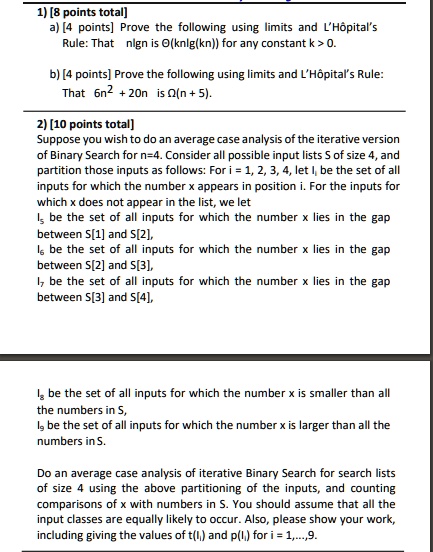
1) [8 points total] a) [4 points] Prove the following using limits and L'Hôpital's Rule: That $n\lg n$ is $O(k n\lg(kn))$ for any constant $k > 0$. b) [4 points] Prove the following using limits and L'Hôpital's Rule: That $6n^2 + 20n$ is $\Omega(n + 5)$. 2) [10 points total] Suppose you wish to do an average case analysis of the iterative version of Binary Search for n=4. Consider all possible input lists S of size 4, and partition those inputs as follows: For i = 1, 2, 3, 4, let $I_i$ be the set of all inputs for which the number x appears in position i. For the inputs for which x does not appear in the list, we let $I_5$ be the set of all inputs for which the number x lies in the gap between S[1] and S[2], $I_6$ be the set of all inputs for which the number x lies in the gap between S[2] and S[3], $I_7$ be the set of all inputs for which the number x lies in the gap between S[3] and S[4], $I_8$ be the set of all inputs for which the number x is smaller than all the numbers in S, $I_9$ be the set of all inputs for which the number x is larger than all the numbers in S. Do an average case analysis of iterative Binary Search for search lists of size 4 using the above partitioning of the inputs, and counting comparisons of x with numbers in S. You should assume that all the input classes are equally likely to occur. Also, please show your work, including giving the values of t($I_i$) and p($I_i$) for i = 1,...,9.
View Answer
divider
BEST MATCH

10.If the Kinetic Energy of an object is doubled, its speed must have increased by a factor of a. \sqrt{2} b. 2 c. 4 d. 6 e. No change in speed f. Speed decreases

View Answer
divider
BEST MATCH

Write a program that takes a file name and a directory name and search for it. Start at a given directory and descends the file tree from that point to search the file with the given file name.

View Answer
divider