Ace - AI Tutor
Ask Our Educators
Textbooks
My Library
Flashcards
Scribe - AI Notes
Notes & Exams
Download App
Jacky Jill

Jacky J.

Divider

Viewed Questions

How to Prepare A Triethanolamine Buffer Shown here is the structure of triethanolamine in its fully protonated form: Its $\mathrm{p} K_{\mathrm{a}}$ is $7.8 .$ You have available at your lab bench $0.1 \mathrm{M}$ solutions of $\mathrm{HCl}, \mathrm{NaOH},$ and the uncharged (free base) form of triethanolamine, as well as ample distilled water. Describe the preparation of a $1 \mathrm{L}$ solution of $0.05 M$ triethanolamine buffer, pH 7.6.

Biochemistry

Questions asked

INSTANT ANSWER

Potassium chlorate upon heating melts at \( 355^{\circ} \mathrm{C} \) and decomposes at \( 480^{\circ} \mathrm{C} . \) In the presence of \( \mathrm{MnO}_{2(\mathrm{~s})} \) catalyst, \( \mathrm{KClO}_{3(\mathrm{~s})} \) completely decomposes into \( \mathrm{O}_{2}(\mathrm{~g}) \) and \( \mathrm{KCl}_{(\mathrm{s})} \). However, \( \mathrm{MnO}_{2(\mathrm{~s})} \) itself does not take part in the overall chemical reaction. In an experiment to determine the gas constant, \( 1.300 \mathrm{~g} \) of pure \( \mathrm{KClO}_{3(\mathrm{~s})} \) and 100 . \( \mathrm{mg} \) of \( \mathrm{MnO}_{2(\mathrm{~s})} \) were mixed in a testube and heated over a bunsen burner. The resulting \( 0_{2(\mathrm{~g})} \) product was bubbled in distilled water that is at exactly \( 25^{\circ} \mathrm{C} \) (or \( 298.15 \mathrm{~K} \) ) and collected in a 100-mL eudiometer. The experiment was done under a barometric pressure of 755 torr. The vapor pressure of water vapor at \( 25^{\circ} \mathrm{C} \) is \( 23.8 \mathrm{mmHg} \). After the reaction was completed, the contents of the testube containing the \( \mathrm{MnO}_{2(\mathrm{~s})} \) catalyst and the \( \mathrm{KCl}_{(\mathrm{s})} \) product was weighed to be \( 1.285 \mathrm{~g} \). The level of the liquid inside the eudiometer rests \( 1.36 \mathrm{~cm} \) below the water level in the reservoir. The graduation on the eudiometer (not shown here) indicates that the trapped gas is \( 88.57 \mathrm{~mL} \). (10 pts)

View Answer
divider
INSTANT ANSWER

OBSERVATIONS a. unknown white powder b. After a simple conductivity test, an aqueous solution of the sample is not conductive. c. After dissolving 22.87 grams of the unknown sample in 0.500 kg of water, the boiling point of the resulting solution was 100.13C under normal atmospheric conditions Given: Kb of water is 0.512 OC/m Using coligative properties: a. Calculate the molality of the resulting solution b. How many moles of the sample did he dissolve to perform the experiment? c. What is the molecular weight of the unknown sample?

View Answer
divider
INSTANT ANSWER

The enthalpy of neutralization of a "new" compound, J(OH)3 is determined using a styroball calorimeter. The calorimeter was first calibrated using 13.00 mL of 0.104 M NaOH and 11.29 mL of 0.125 M HCl (?H = -55.85 kJ/mol) and a temperature rise of 4.6 °C was recorded. Using the same calorimeter, 7.58 mL of 0.151 M of J(OH)3 was reacted with 9.60 mL of 0.125 M HCl and the temperature changed from 25.9 °C to 23.4 °C. --------- a. What is the heat capacity of the calorimeter? --------- b. Write the balanced chemical equation for the reaction between J(OH)3 and HCl. --------- c. Identify the limiting reactant in the reaction between J(OH)3 and HCl. ---------- d. What is the enthalpy of the reaction of J(OH)3 and HCl? ---------

View Answer
divider
ANSWERED

Mahipal Kumawat verified

Numerade educator

(Boiling point estimation from entropy) Estimate the normal boiling point of chloroform (in °C) given that the standard entropy and enthalpy of vaporization of chloroform is 93.7 J/mol·K and 31.4 kJ/mol, respectively.

View Answer
divider
ANSWERED

Hitendra Singh verified

Numerade educator

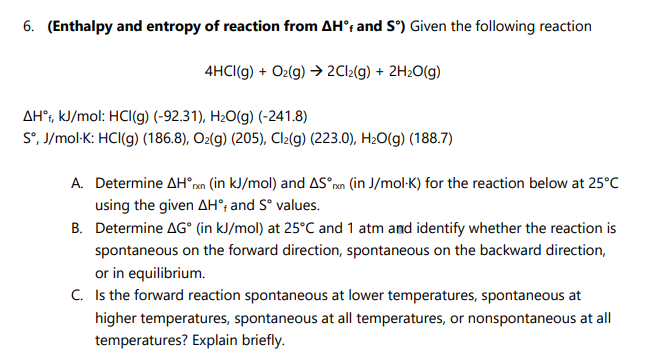
6. (Enthalpy and entropy of reaction from ?H°f and S°) Given the following reaction 4HCl(g) + O2(g) ? 2Cl2(g) + 2H2O(g) ?H°f, kJ/mol: HCl(g) (-92.31), H2O(g) (-241.8) S°, J/mol·K: HCl(g) (186.8), O2(g) (205), Cl2(g) (223.0), H2O(g) (188.7) A. Determine ?H°rxn (in kJ/mol) and ?S°rxn (in J/mol·K) for the reaction below at 25°C using the given ?H°f and S° values. B. Determine ?G° (in kJ/mol) at 25°C and 1 atm and identify whether the reaction is spontaneous on the forward direction, spontaneous on the backward direction, or in equilibrium. C. Is the forward reaction spontaneous at lower temperatures, spontaneous at higher temperatures, spontaneous at all temperatures, or nonspontaneous at all temperatures? Explain briefly.
View Answer
divider
INSTANT ANSWER

(Phase change) Calculate the total amount of heat absorbed (in kJ) when 3.00 mol of ice at -20.0°C is converted to steam at 150.0°C. Given the following values: cP (ice) = 2.06 J/g · °C cP (water) = 4.18 J/g · °C cP (steam) = 1.87 J/g · °C ?Hfus = 6.01 kJ/mol ?Hvap = 40.7 kJ/mol

View Answer
divider
ANSWERED

Mahipal Kumawat verified

Numerade educator

(Internal Energy) A system performs 720. L · atm of pressure–volume work (1 L · atm = 101.325 J) on its surroundings and absorbs 5750. J of heat from its surroundings. What is the change in internal energy ?U (in J) of the system?

View Answer
divider
INSTANT ANSWER

\( \mathrm{} \) \( 945 \textrm \) \( \mathrm{} \) \( \mathrm{} \)

View Answer
divider
ANSWERED

Madhur L verified

Numerade educator

(Hess's Law) Determine the heat of formation ?H

View Answer
divider
ANSWERED

Susan Hallstrom verified

Numerade educator

(Stoichiometry) Methylhydrazine (CH6N2) is burned with dinitrogen tetroxide in the attitude-control engines of the space shuttles. CH6N2(l) + N2O4(l) ? CO2(g) + H2O(l) + N2(g) The two substances ignite instantly on contact, producing a flame temperature of 3000. K. The energy liberated per 0.100 g of CH6N2 at constant atmospheric pressure after the products are cooled back to 25°C is 750. J. A. Find ?H (in kJ/mol) for the reaction above. B. How many kilojoules are liberated when 87.5 g of N2 is produced?

View Answer
divider