▸ The Effect of Several Different Electrode Materials on the Effectiveness of Micro-Supercapacitors
1. Introduction
Recent developments within the field of wearable computers, wireless sensor technology, on top of reducing
chip sizes, and other technological developments have led to market demand for smaller and smaller micro
energy storage devices (MESD). MESD is the all-encompassing term for r micro batteries and capacitors that can
be built either in 2D or 3D configurations. The use of specifically Micro Super capacitors (MSC) is becoming
more and more common for these technologies as they, often have a higher rate of power dissipation as well as a
lack of reliance on a liquid electrolyte that as the lifespan ends can often fail catastrophically, damaging
surrounding components. The efficiency in MSCs is highly important for the future development of computer
systems, and as a result of several factors, current MESD technology has been lagging the rest of the
technological development cycle [6] in this domain.
Micro supercapacitors, whether designed in 2D or 3D configurations, share common components, requiring
electrodes to current collectors and an electrolyte to act as a separator for effective charge storage
between the two substrates. Rather than relying on dielectric plates, a supercapacitor accumulates electrical
energy through capacitive adsorption and desorption of ions or through pseudo-capacitive Faradaic reactions
between an electrode and an electrolyte [7]. The selection of electrode materials significantly impacts both the
efficiency and power density of the device. Numerous electrode materials have been evaluated in terms of
cycling efficiency, power density, and degradation over discharge cycles; however, a clear comparison among
these materials would enhance future development efforts and increase their effectiveness.
In a 2020 study, a compilation of data on various Lithium manganese oxide (LMO) variants as electrodes
revealed that these materials generally show encouraging cycling stability, indicating their potential as suitable
electrode options [8]. Since the aggregation of findings from multiple studies can influence any comparisons due
to factors beyond the independent variable, it's essential to note this variability. Given their promising
performance highlighted in previous research, it's crucial to compare LMO with other potential materials to
enhance future understanding. Likewise, a 2019 review examined recent advancements in MSCs, particularly
focusing on carbon-based electrode design and various manufacturing methods [18]. The conclusions of this
article underscored the feasibility of these carbon-based materials, which can be further explored in this
proposed research.
2. Aim, Expected Outcomes and Research Questions
This proposed study intends to evaluate various electrode materials in the framework of micro-supercapacitors, utilizing a
consistent set of electrolytes, fabrication methods, and design configurations. This approach will facilitate the examination
of the impact on efficiency, power density, and discharge rate of MSCs with different electrode materials. The goal of this
research is to generate a more comprehensive dataset about the materials used in construction, which can then be applied
to future research and development efforts.
Several electrode materials have been examined previously, particularly in categories such as Lithium manganese oxide,
carbide-derived carbon, conducting polymers (including Polyaniline (PANI) nanowire arrays), and MXenes. There exists a
vast array of potential materials, but these have been identified in earlier studies as having significant promise as
conductive elements in this context. As a result, the primary research questions this proposed study will address are listed
below:
How does the Material of the electrode within a MSC effect the Power density of the MSC?
How does the Material of the electrode within a MSC effect the Energy density of the MSC?
How does the Material of the electrode within a MSC effect the cycle stability of the MSC?
3. Study Design/approach
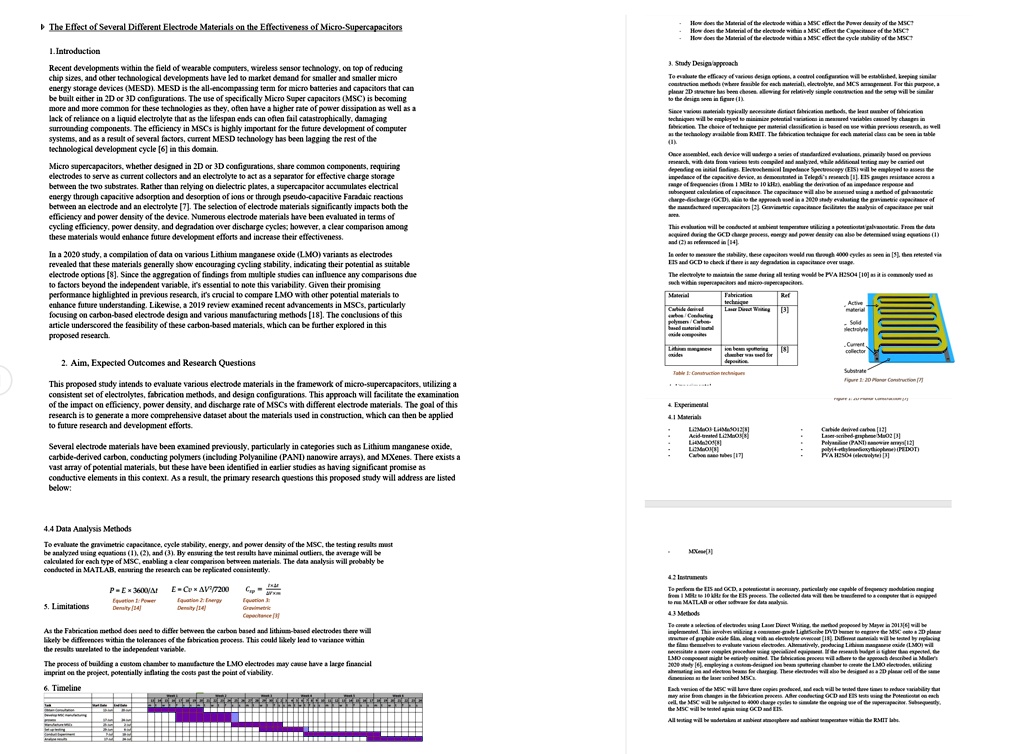
To evaluate the efficacy of various design options, a control configuration will be established, keeping a similar
planar 2D structure has been chosen, allowing for relatively single construction and the setup will be simple
since design will be employed mainly to maintain fabrication methods, the least number of fabrication
techniques seen in figure (13).
Since various materials typically necessitate distinct variation in numerous variables caused by changes in
fabrication technology, each device will undergo a series of standardized evaluations, based on previous research.
Once assembled, the device will undergo material classification for each material primarily based on previous
research, with initial findings. Electrochemical impedance spectroscopy (EIS) will be employed to assess the
range of frequencies (from 1 mHz to 10 kHz) and analyzed, while additional testing may be carried out
depending on data from various tests completed and nullifying the derivation of an impedance response and
subsequent calculations of capacitance. The capacitance will also be analyzed using a gravimetric galvanostatic
charge-discharge (GCD) of the approach used in 2020 study including the method of capacitance
measurement [14]. This approach will allow us to identify and evaluate the effectiveness of each material.
This evaluation will be conducted at ambient temperature utilizing a potentiostatic galvanostatic. From the data
acquired during the GCD process, energy and power density can also be determined using equations (1)
and (2) as referenced in [14].
In order to measure the stability, any capacitors would run through 6000 cycles as is commonly used via
EIS and GCD to check if there is any degradation over PVA/H2SO4 usage [10] as is seen, then retested via
the electrolyte to maintain these same testing all would be done over MSCs.
Table 1: Construction techniques
4. Experimental
4.1 Materials
Li2MnO3(LMO2018)
Acid treated Li2MnO3(LMO2018)
LiMn2O4(LMO)
Carbon nano tubes [17]
Carbide derived carbon [12]
Acid treated Li2MnO3(LMO2018)
Laser Direct Writing
Fabrication
Cathode material
Conducting
polymer
Carbon material
based composites
Lithium manganese
oxide
Laser Direct Writing
Active material
Electrolyte
Current collector
Substrate
Figure 2: 2D Planer Construction [7]
Polyaniline (PANI) nanowire arrays [12]
PEDOT:PSS [13]
PVA H2SO4 electrolyte[1]
4.2 Instruments
MX600[1]
To perform the EIS and GCD, a potentiostat is necessary, particularly one capable of frequency modulation ranging
to run MATLAB or other software using Data Direct.
4.3 Methods
To create a selection of electrodes using Laser Direct Writing, the method proposed in Mayer et al [15] will be adapted
for this study. This involves creating electrodes. Specifically, producing Lithium manganese oxide (LMO) will
involve a more complex procedure using a specialized Lifescribe laser writer to engrave the LMO onto a 2D planar
implementation. This intricate process eliminates graduate equipment, the budget research might expect, unless the
2020 version [6] employing three designed produced electrodes will be created as 2D planar cells, utilizing that
same fabrication process.
Each version of the MSC will have three components. Their charging will be designed times reducing the same
NOS testing (EIS), reducing charged capacitors, soon and each will be tested three times reducing variability that
may arise from changes in the fabrication process. After conducting EIS and GCD testing using the Potentiostat,
the MSC will be tested again using GCD process and measuring the output energies of the supercapacitor on each.
All testing will be undertaken at ambient and subambient temperature within the RMIT labs.
4.4 Data Analysis Methods
To evaluate the gravimetric capacitance, cycle energy, and power density of the MSC, the testing results must
be analyzed using equations (1), (2), and (3). By ensuring the test results have minimal outliers, the average will be
calculated for each type of MSC, enabling a clear comparison between materials. The data analysis will probably be
conducted in MATLAB, ensuring the research can be replicated consistently.
$P = \frac{E \times 3600}{A \times \Delta t}$ $E = \frac{C \times V^2}{7200}$ $C = \frac{\Delta Q}{\Delta V}$
Equation 1: Power
Equation 2: Energy
Equation 3: Capacitance
5. Limitations
As the Fabrication method does need to differ between the carbon based and lithium-based electrodes there will
likely be differences within tolerances of the fabrication process. This could likely lead to variance within
the results unrelated to the independent variable.
The process of building a custom chamber to manufacture the LMO electrodes may cause a large financial
impact on the project, potentially inflating the cost past the point of viability.
6. Timeline