Question 8 of 12, 15 pts
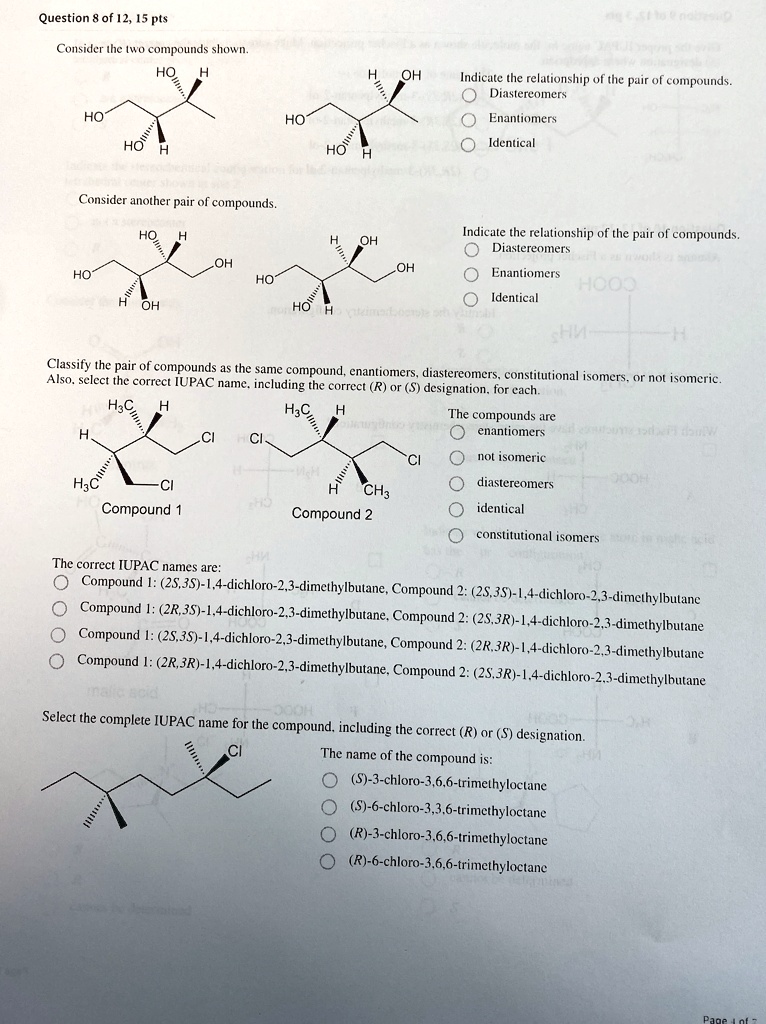
Consider the two compounds shown.
H
OH
Indicate the relationship of the pair of compounds.
Diastereomers
XX=
HO H
HO
HỒ H
HO
Enantiomers
Identical
HỒ H
Consider another pair of compounds.
HO
H
OH
HO
HO
OH
OH
Indicate the relationship of the pair of compounds.
Diastereomers
OH
Enantiomers
Identical
HO
HO
H
Classify the pair of compounds as the same compound, enantiomers, diastereomers, constitutional isomers, or not isomeric.
Also, select the correct IUPAC name, including the correct (R) or (S) designation, for each.
H3C
H
H3C
H
H
CI
CI
The compounds are
Oenantiomers
H3C
CI
Compound 1
CI
CH3
HO
Compound 2
not isomeric
diastereomers
identical
constitutional isomers
The correct IUPAC names are:
Compound 1: (2S,3S)-1,4-dichloro-2,3-dimethylbutane, Compound 2: (2S,3S)-1,4-dichloro-2,3-dimethylbutane
Compound 1: (2R,3S)-1,4-dichloro-2,3-dimethylbutane, Compound 2: (2S,3R)-1,4-dichloro-2,3-dimethylbutane
Compound 1: (2S,3S)-1,4-dichloro-2,3-dimethylbutane, Compound 2: (2R,3R)-1,4-dichloro-2,3-dimethylbutane
Compound 1: (2R,3R)-1,4-dichloro-2,3-dimethylbutane, Compound 2: (2S,3R)-1,4-dichloro-2,3-dimethylbutane
malic acid
Select the complete IUPAC name for the compound, including the correct (R) or (S) designation.
CI
The name of the compound is:
(S)-3-chloro-3,6,6-trimethyloctane
(S)-6-chloro-3,3,6-trimethyloctane
(R)-3-chloro-3,6,6-trimethyloctane
(R)-6-chloro-3,6,6-trimethyloctane
Page