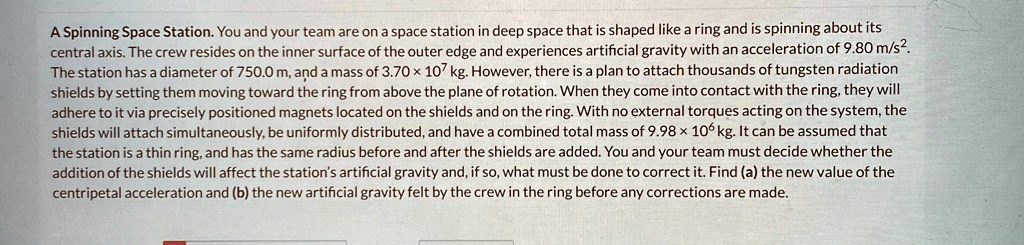
A Spinning Space Station. You and your team are on a space station in deep space that is shaped like a ring and is spinning about its central axis. The crew resides on the inner surface of the outer edge and experiences artificial gravity with an acceleration of 9.80 m/s². The station has a diameter of 750.0 m, and a mass of 3.70 × 10$^7$ kg. However, there is a plan to attach thousands of tungsten radiation shields by setting them moving toward the ring from above the plane of rotation. When they come into contact with the ring, they will adhere to it via precisely positioned magnets located on the shields and on the ring. With no external torques acting on the system, the shields will attach simultaneously, be uniformly distributed, and have a combined total mass of 9.98 × 10$^6$ kg. It can be assumed that the station is a thin ring, and has the same radius before and after the shields are added. You and your team must decide whether the addition of the shields will affect the station's artificial gravity and, if so, what must be done to correct it. Find (a) the new value of the centripetal acceleration and (b) the new artificial gravity felt by the crew in the ring before any corrections are made.