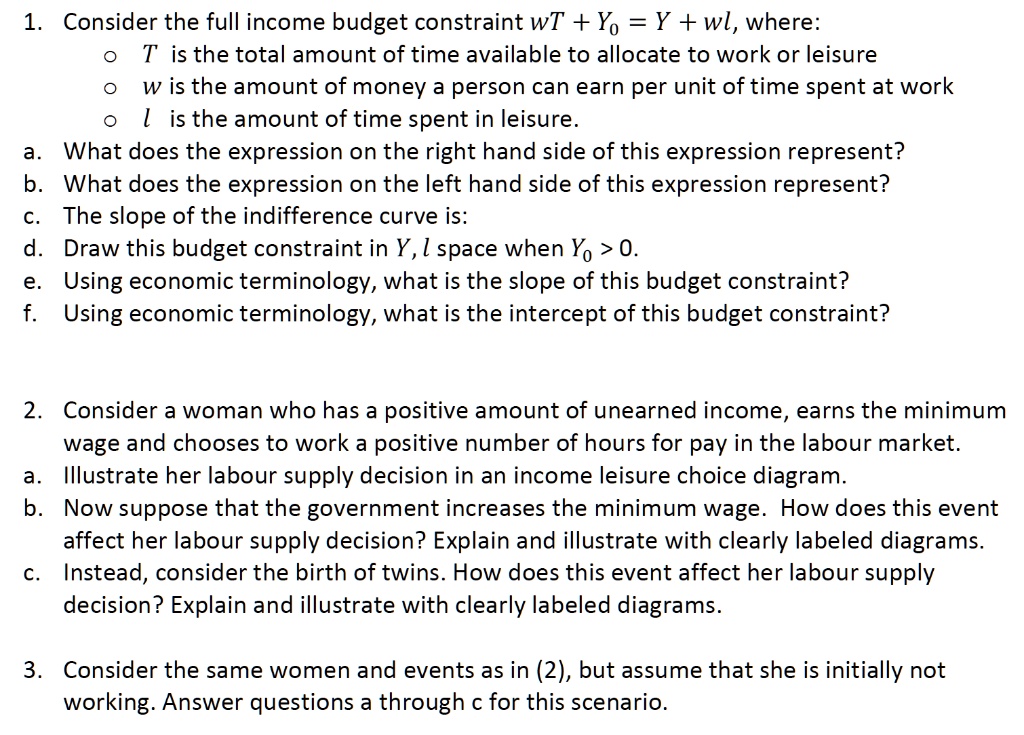
1. Consider the full income budget constraint wT + Y<sub>0</sub> = Y + wl, where:
? T is the total amount of time available to allocate to work or leisure
? w is the amount of money a person can earn per unit of time spent at work
? l is the amount of time spent in leisure.
a. What does the expression on the right hand side of this expression represent?
b. What does the expression on the left hand side of this expression represent?
c. The slope of the indifference curve is:
d. Draw this budget constraint in Y, l space when Y<sub>0</sub> > 0.
e. Using economic terminology, what is the slope of this budget constraint?
f. Using economic terminology, what is the intercept of this budget constraint?
2. Consider a woman who has a positive amount of unearned income, earns the minimum
wage and chooses to work a positive number of hours for pay in the labour market.
a. Illustrate her labour supply decision in an income leisure choice diagram.
b. Now suppose that the government increases the minimum wage. How does this event
affect her labour supply decision? Explain and illustrate with clearly labeled diagrams.
c. Instead, consider the birth of twins. How does this event affect her labour supply
decision? Explain and illustrate with clearly labeled diagrams.
3. Consider the same women and events as in (2), but assume that she is initially not
working. Answer questions a through c for this scenario.