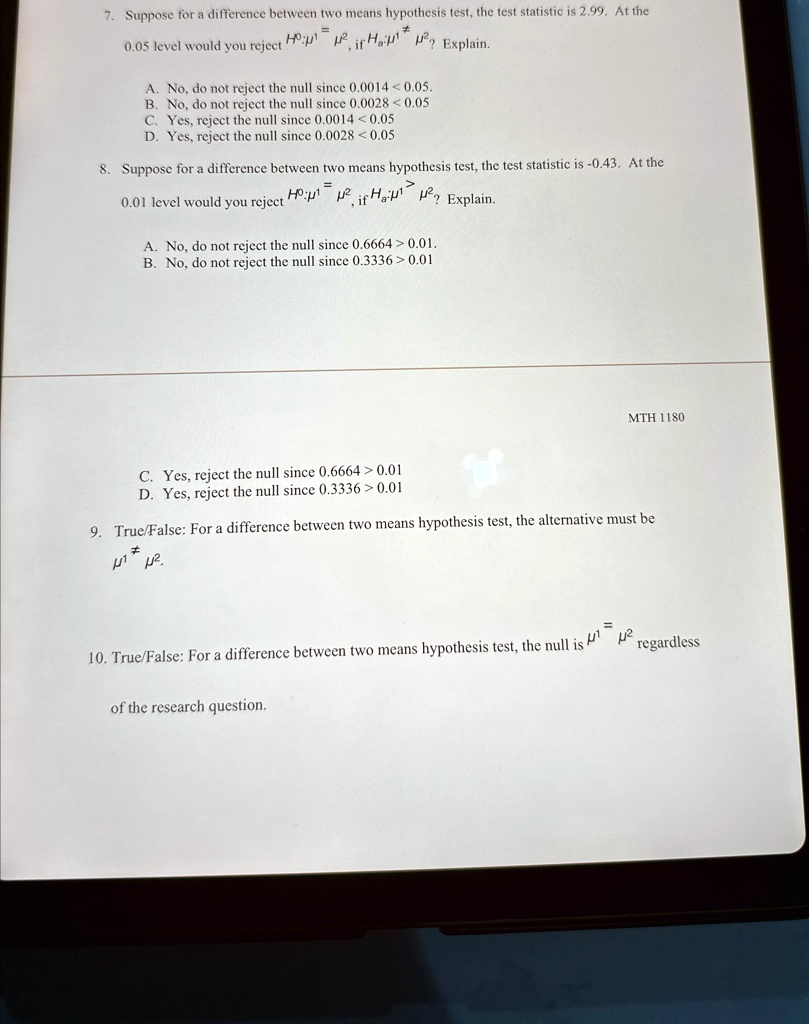
Suppose for a difference between two means hypothesis test, the test statistic is 2.99 . At the 0.05 level would you reject H^(0):mu ^(1)=mu ^(2), if H_(a):mu ^(1)mu ^(2) ? Explain.
A. No, do not reject the null since 0.0014<0.05.
B. No, do not reject the null since 0.0028<0.05
C. Yes, reject the null since 0.0014<0.05
D. Yes, reject the null since 0.0028<0.05
Suppose for a difference between two means hypothesis test, the test statistic is -0.43 . At the 0.01 level would you reject H^(0):mu ^(1)=mu ^(2), if H_(a):mu ^(1)mu ^(2) ? Explain.
A. No, do not reject the null since 0.6664>0.01.
B. No, do not reject the null since 0.3336>0.01
MTH 1180
C. Yes, reject the null since 0.6664>0.01
D. Yes, reject the null since 0.3336>0.01
True/False: For a difference between two means hypothesis test, the alternative must be mu ^(1)mu ^(2).
True/False: For a difference between two means hypothesis test, the null is mu ^(mu ^(1))mu ^(2) regardless of the research question.
7. Suppose for a difference between two means hypothesis test, the test statistic is 2.99. At the
A.No,do not reject the null sincc 0.0014<0.05 B.No,do not reject the null since 0.0028<0.05 C.Yes,reject the null since 0.0014<0.05 D.Yes,reject the null since 0.0028<0.05
8. Suppose for a difference between two means hypothesis test, the test statistic is -0.43. At the
A.No,do not reject the null since 0.6664>0.01 B.No,do not reject the null since 0.3336>0.01
MTH1180
C.Yes, reject the null since 0.6664>0.01 D. Yes, reject the null since 0.3336>0.01
9.True/False: For a difference between two means hypothesis test, the alternative must be
of the research question.