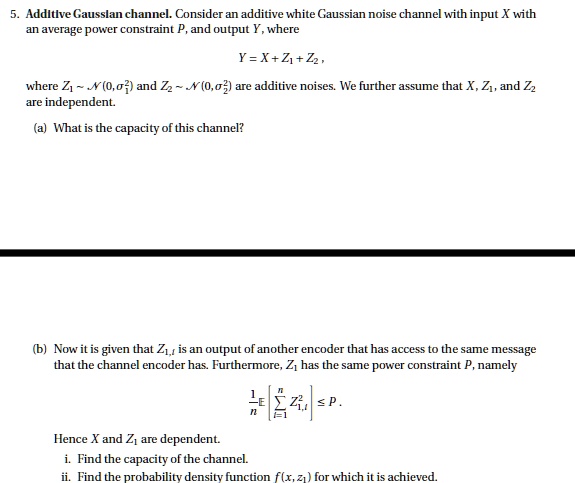
5. Additive Gaussian channel. Consider an additive white Gaussian noise channel with input X with
an average power constraint P, and output Y, where
Y = X + Z_1 + Z_2,
where Z_1 ~ \mathcal{N}(0, \sigma_1^2) and Z_2 ~ \mathcal{N}(0, \sigma_2^2) are additive noises. We further assume that X, Z_1, and Z_2
are independent.
(a) What is the capacity of this channel?
(b) Now it is given that Z_{1,i} is an output of another encoder that has access to the same message
that the channel encoder has. Furthermore, Z_1 has the same power constraint P, namely
\frac{1}{n}E\left[\sum_{i=1}^n Z_{1,i}^2\right] \leq P.
Hence X and Z_1 are dependent.
i. Find the capacity of the channel.
ii. Find the probability density function \(f(x, z_1)\) for which it is achieved.